Turning VA Benefits into a Scuba Diving Career
I’m Ciara—a PADI Master Instructor and Army veteran who found a second career underwater. When I left the military, I knew I wanted to do something active, meaningful, and different from the typical 9-to-5—but I had no idea where to start.
That’s where Veteran Readiness & Employment (VR&E) came in. With the support of this program, I was able to retrain, earn professional scuba certifications, and build a new path doing work I truly love. But I won’t lie—navigating the VR&E system was confusing at first. There’s a lot of paperwork, a lot of acronyms, and not always a clear roadmap, especially if you’re pursuing something outside the traditional college route.
Like many of you, I had questions:
“Where do I start? What benefits can I use? Is this even possible?”
The answer is yes—and I’m here to support you.
In this guide, I’ll walk you through the exact steps, resources, and benefits you can use —including Chapter 31 (VR&E), Chapter 33 (Post-9/11 GI Bill), and Chapter 35 (DEA)—to help you navigate your own path from veteran to certified scuba professional.
📘 Chapter 31 (VR&E): Building a New Career from the Ground Up
Who It’s For:
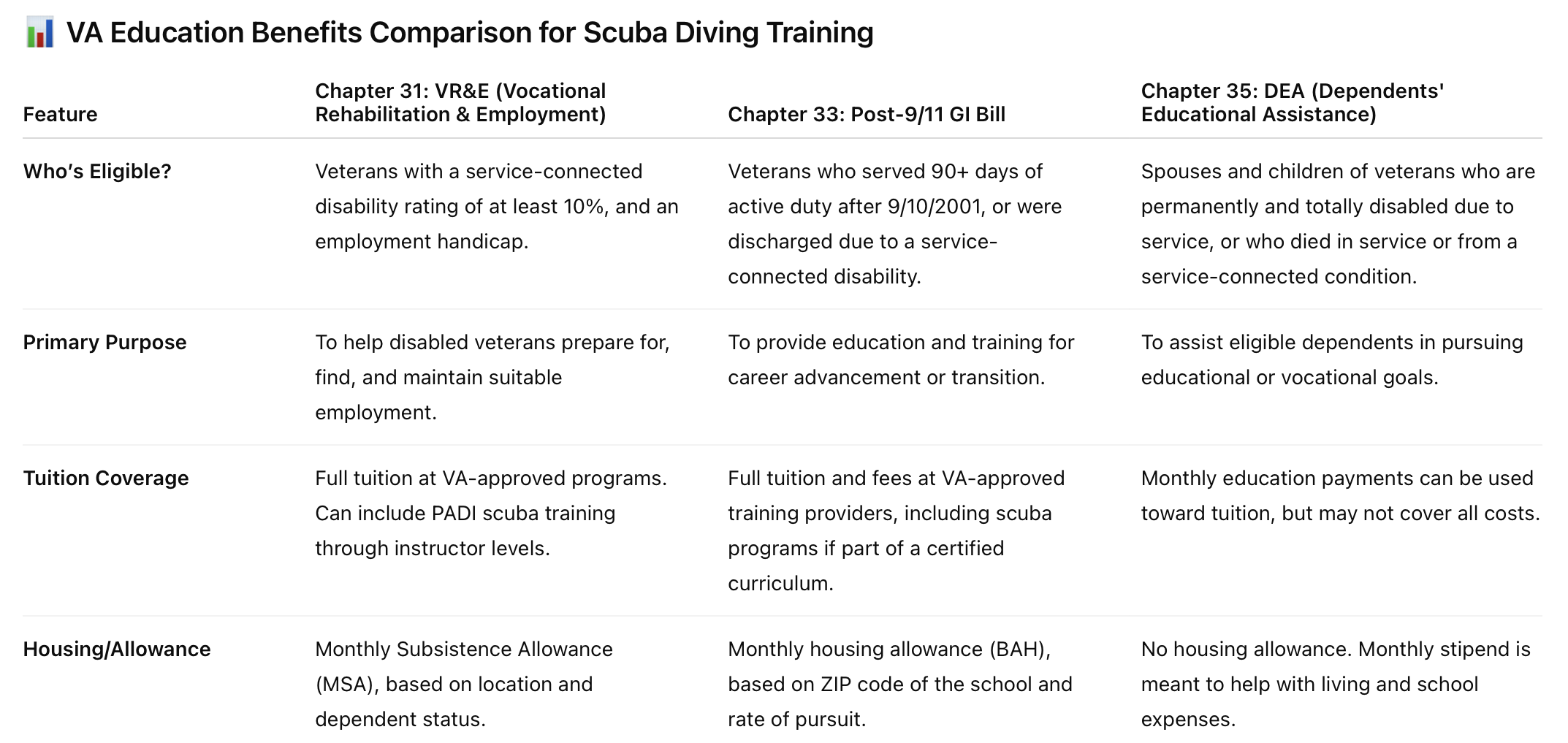
Veterans with a service-connected disability (10% or higher) and an employment barrier.
How It Leads to a Career:
Career Counseling – You'll work directly with a VR&E counselor to craft a detailed rehabilitation plan, which can include training through PADI dive centers.
Training Pathway:
This is the stage where you need to start thinking seriously about your long-term goals. Do you want to stay on the path as a scuba instructor? Are you aiming to become a Course Director someday? Maybe your dream is to open your own dive shop. These are the kinds of questions you’ll need to answer as you work with your VR&E counselor to develop your personalized training plan.
Open Water → Advanced → Rescue → Divemaster → IDC (Instructor Development Course)
Includes EFR (Emergency First Response) training and even Course Director Prep in some cases.
Covered Costs:
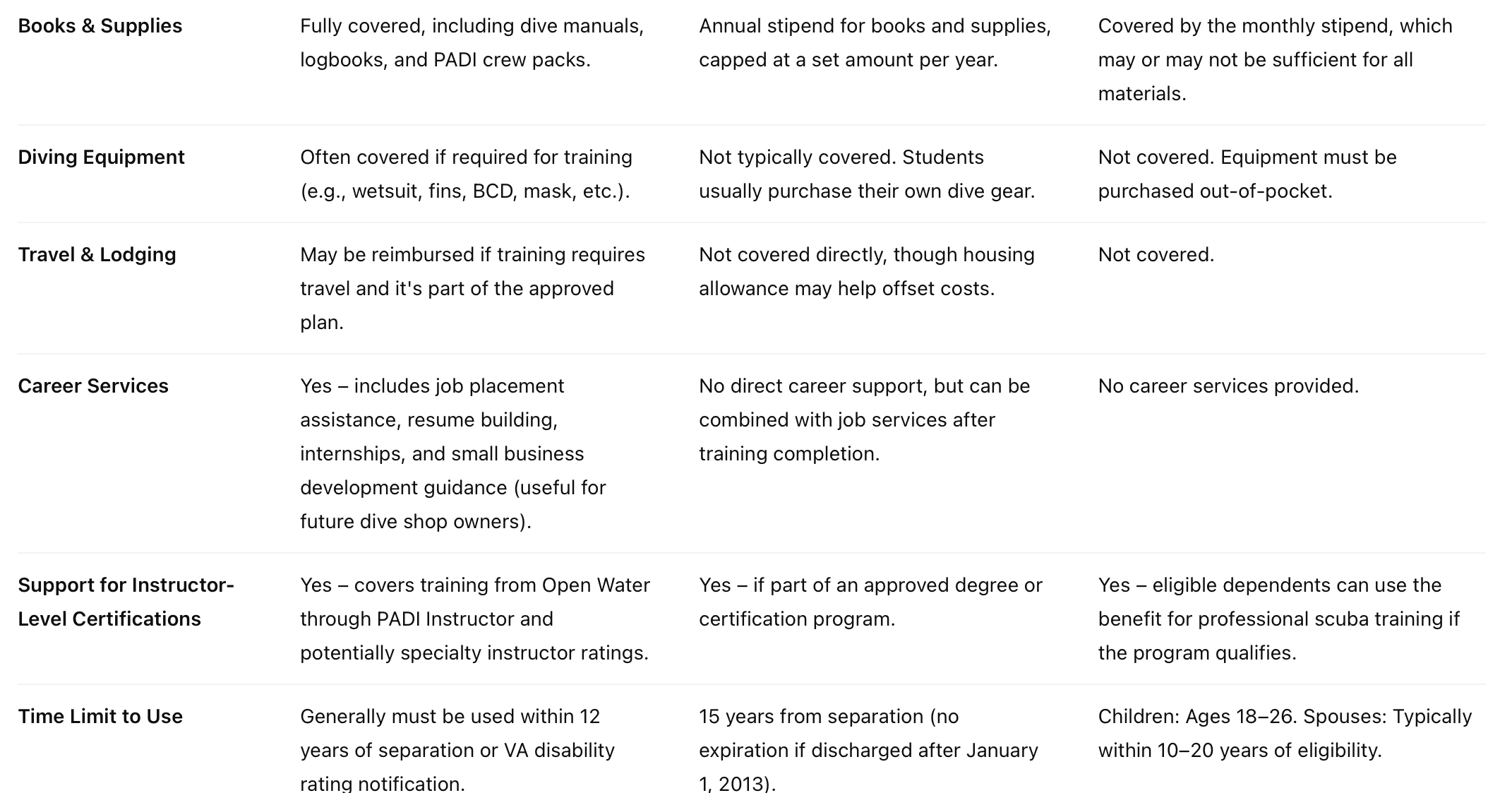
Tuition and equipment!
You'll need to provide a clear justification for any equipment required for your training. Your Course Director can be a valuable resource here—they should be able to help you explain why each item is necessary for your professional development.
Long-Term Support:
Job placement services to help you find work at a dive resort, on a liveaboard, or even contract opportunities in marine services.
May include business planning services if you want to open a dive shop.
Ideal Career Fit:
Veterans looking to retrain for a new career with full support, particularly those transitioning with injuries, PTSD, or mobility limitations. Many find that working underwater is therapeutic and empowering.
🧭 Chapter 33 (Post-9/11 GI Bill): Flexible, Transferable, Career-Ready
Who It’s For:
Veterans with at least 90 days of active-duty service after September 10, 2001, or those discharged with a service-connected disability after 30 days.
How It Leads to a Career:
Scalable Learning – You can start your scuba education part-time while attending college or go full-throttle into professional training.
Benefit Transfer – Allows you to transfer unused benefits to your spouse or children, meaning your family can join you on your journey or build their own. How to transfer changes regularly, check with your VA office for information.
Ideal for Instructor Certification:
Use it to fund your way to becoming a PADI Instructor, then pursue specialty instructor certifications (wreck diving, deep diving, night diving, etc.) to enhance your hireability.
Housing Support – Monthly Housing Allowance (MHA) lets you focus on training full-time without financial stress.
Long-Term Support:
Use the GI Bill Comparison Tool to find PADI 5-Star Instructor Development Centers (IDCs) that are VA-approved and offer internships, mentorships, and even job placement after certification.
🎓 Chapter 35 (DEA): Empowering Dependents to Build Dive Careers
Who It’s For:
Spouses and children of veterans who are 100% permanently disabled, MIA, or deceased due to service-related conditions.
How It Leads to a Career:
Supportive Start – Use your DEA benefits to fund professional dive education starting at 18 (or younger for some programs).
Long-Term Education – DEA benefits can be used for over 3 years and 9 months of training, allowing full progression to Instructor and beyond.
Adaptability – Great for young adults interested in:
Marine sciences
Outdoor education
Conservation diving
Underwater photography and media
Ideal Fit:
Families of veterans who want to build a meaningful, mobile career that allows them to travel, teach, and make a difference in the environment and veteran communities.
🏝️ The Roadmap to Becoming a PADI Dive Instructor with VA Benefits
Step-by-Step (Fully Fundable Path):
Open Water Diver
Your first step into the underwater world—learn the fundamentals of scuba diving and earn your entry-level certification.Advanced Open Water Diver
Build confidence, expand your skills, and explore new types of diving like deep, navigation, and night dives.Rescue Diver
Become a more aware and capable diver by learning to prevent, recognize, and respond to diving emergencies.Emergency First Response (EFR)
Gain essential CPR and first aid skills to respond to medical emergencies, both in and out of the water.Divemaster
Take the first step into the professional world of diving—mentor others, guide dives, and assist with training.Instructor Development Course (IDC)
Learn how to teach scuba diving and develop the skills to train and certify new divers at multiple levels.Instructor Exam (IE)
Put your training to the test—this is the final step in becoming a certified PADI Open Water Scuba Instructor.Master Scuba Diver Trainer (MSDT) Prep
Expand your teaching portfolio by learning to certify students in multiple PADI Specialty courses.
💡 All these steps can be covered through Chapter 31, Chapter 33, or Chapter 35, provided you’re training at a VA-approved PADI facility.

🌊 Final Inspiration: Dive Into Your Next Adventure
Veterans often seek new purpose after military service. Scuba instruction offers that purpose, paired with adventure, leadership, and the satisfaction of helping others conquer the underwater world. Whether you become a local dive shop mentor, a globe-trotting instructor, or a conservation warrior, your VA benefits can open the door to a life of freedom, fulfillment, and deep connection—with the ocean and with others.
Dive safe, explore passionately, and remember…