
The Wonderful, Weird World of Octopuses
From coconut octopuses carrying their own portable shelters to the enormous giant Pacific octopus and incredible masters of disguise, discover the fascinating behaviors, surprising intelligence, and extraordinary adaptations that make octopuses some of the ocean’s most wonderful, weird creatures.
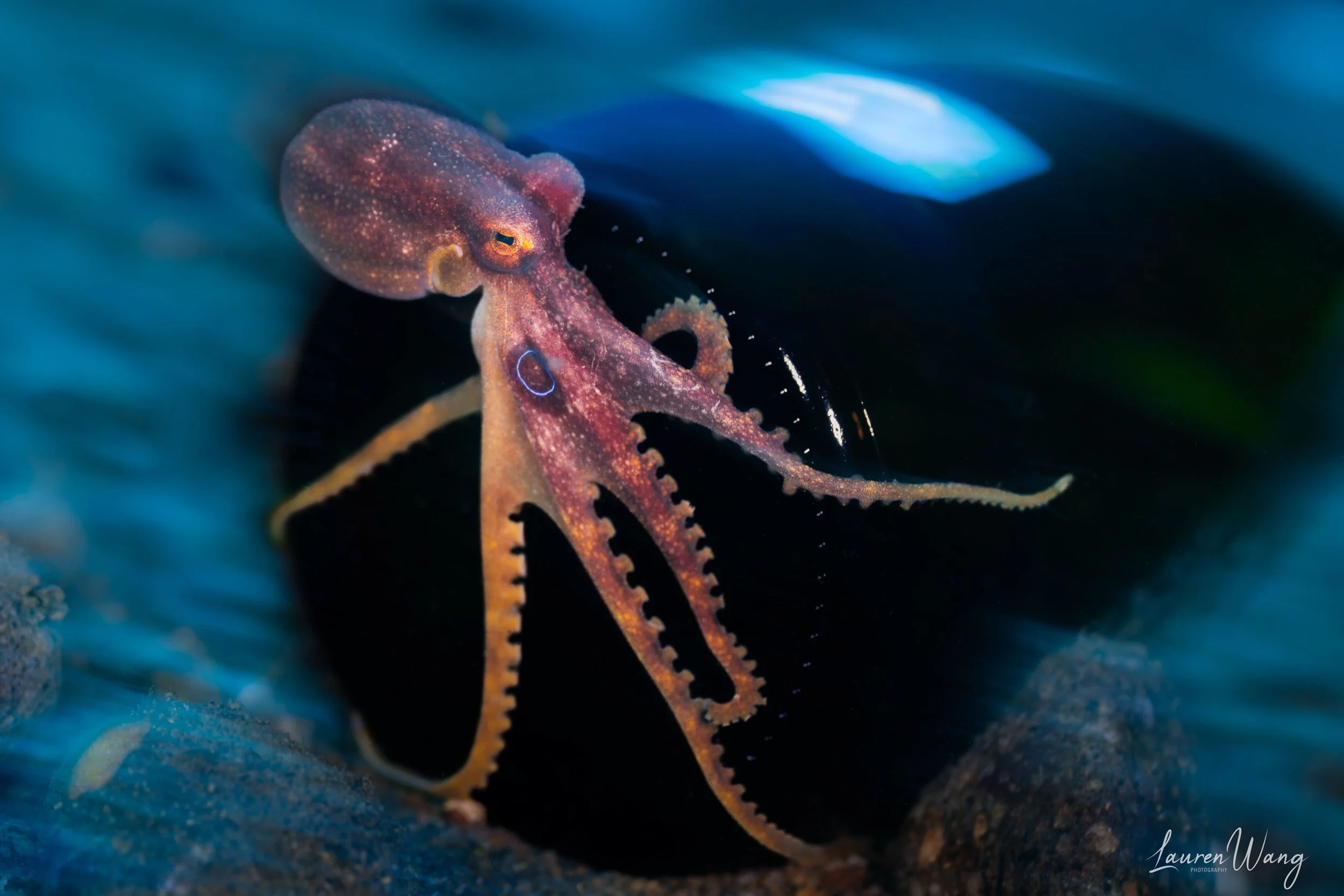
A little mototi octopus (Amphioctopus mototi) photographed in the Philippines! Such a tiny, fascinating octopus with some seriously beautiful markings!
Photo courtesy of Lauren Wang
Photographer Spotlight: The Talent Behind the Lens
Before we dive into the wonderful, weird world of octopuses, I want to give a special thank you to Byron Conroy, Lauren Wang, Matthew Sullivan, and Becky Stankevitz for so generously sharing their beautiful underwater photography for this article!
I have so much admiration for these photographers and the incredible work they create underwater. Each has their own artistic style and a wonderful way of capturing the colors, details, behaviors, and personalities that make marine life so fascinating. Underwater photography is so much more than documenting what we encounter beneath the surface. It's an art form, and I love seeing how each photographer brings their own perspective to the underwater world.
I'm genuinely grateful for their kindness and willingness to share their work. I hope their photographs inspire you to appreciate these incredible animals in a new way and encourage you to explore more of their photography. They're all incredibly talented, and I'm so happy to share their work with you!
Go check out these amazing photographers:
Byron Conroy
Lauren Wang
Matthew Sullivan
Becky Stankevitz
Thank you all again for helping bring the wonderful, weird world of octopuses to life through your photography!
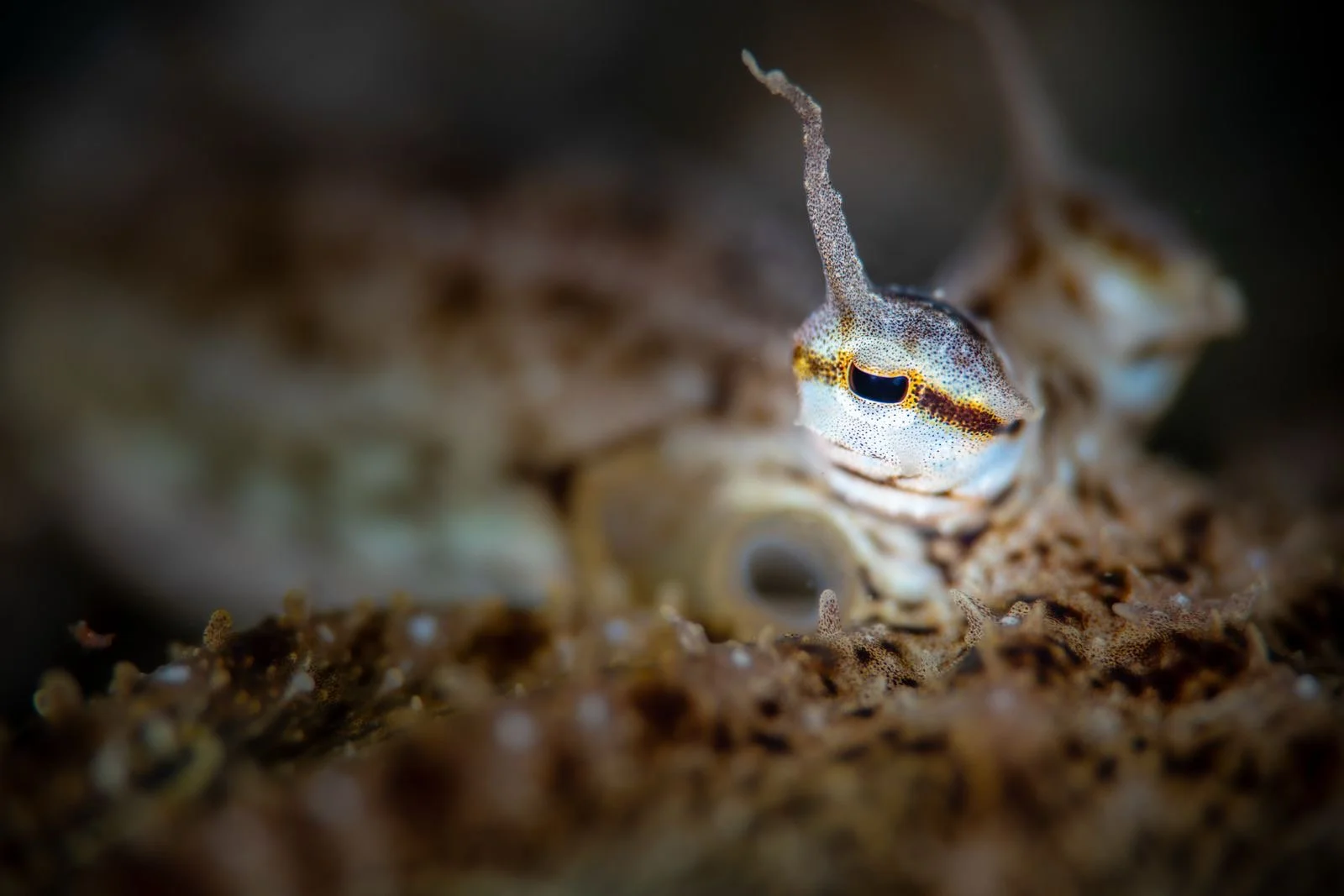
A closer look at the incredible mimic octopus (Thaumoctopus mimicus), with its beautifully patterned eyes peeking out. Such an amazing perspective on one of the ocean’s most fascinating masters of disguise!
Photo courtesy of Byron Conroy
Let’s Deep Dive
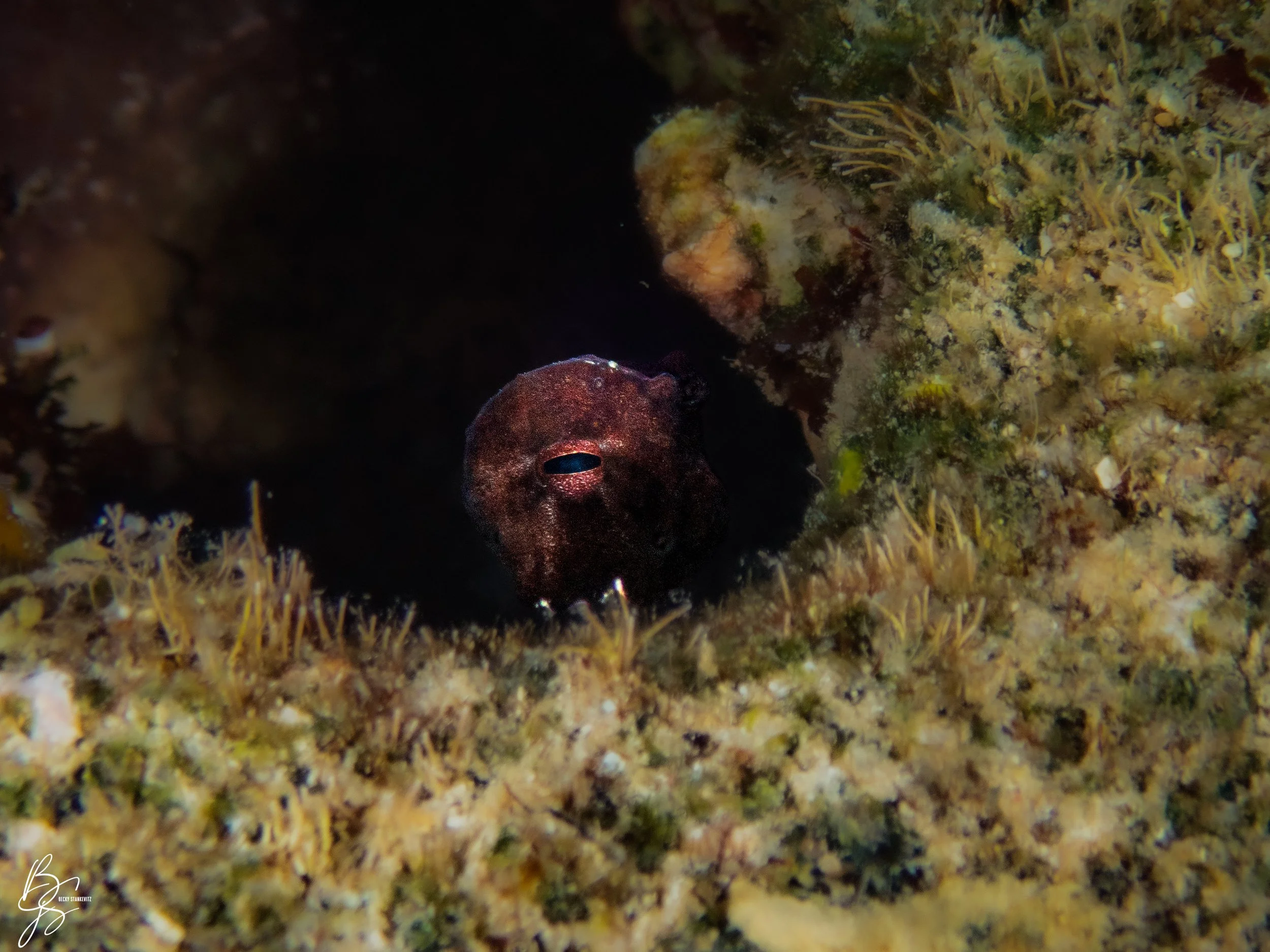
Someone's keeping an eye on us! This little octopus is peeking out from its cozy reef hideaway in Fiji.
Photo courtesy of Becky Stankevitz
You know that moment when you're diving along a reef, spot something slightly unusual, and suddenly realize the rock you've been staring at has eight arms? Few things make me happier underwater than finding an octopus. I love sharks, turtles, and all the other incredible marine animals we encounter while diving, but octopuses are my favorite, hands down. Maybe it's their intelligence, their ability to disappear right in front of you, or the fact that they sometimes look genuinely annoyed when you discover their hiding place. Whatever the reason, I'll happily spend an unreasonable amount of a dive watching one go about its business.
My trip to Lembeh, Indonesia, was particularly exciting because we encountered an incredible variety of octopuses, including mimic, wunderpus, mototi, blue-ringed, algae, long-arm, and coconut octopuses. For someone who has been obsessed with these animals for years, seeing so many different kinds in one destination was pretty spectacular. Lembeh is famous for muck diving, where seemingly ordinary stretches of sand, rubble, and sediment hide some of the most unusual marine life imaginable. You might spend several minutes examining what appears to be an empty patch of seafloor, only to discover something extraordinary hiding right in front of you.
Scientists recognize roughly 300 species of octopus, although the exact number continues to change as researchers describe new species and revise classifications. Octopuses inhabit environments ranging from shallow tropical reefs to the deep ocean, and their appearances, hunting strategies, reproductive behaviors, and defenses vary enormously. Some imitate other animals, some carry objects to build shelters, and others possess venom powerful enough to threaten human life. Their biology is already fascinating, but the differences between species are what make them particularly interesting to me.
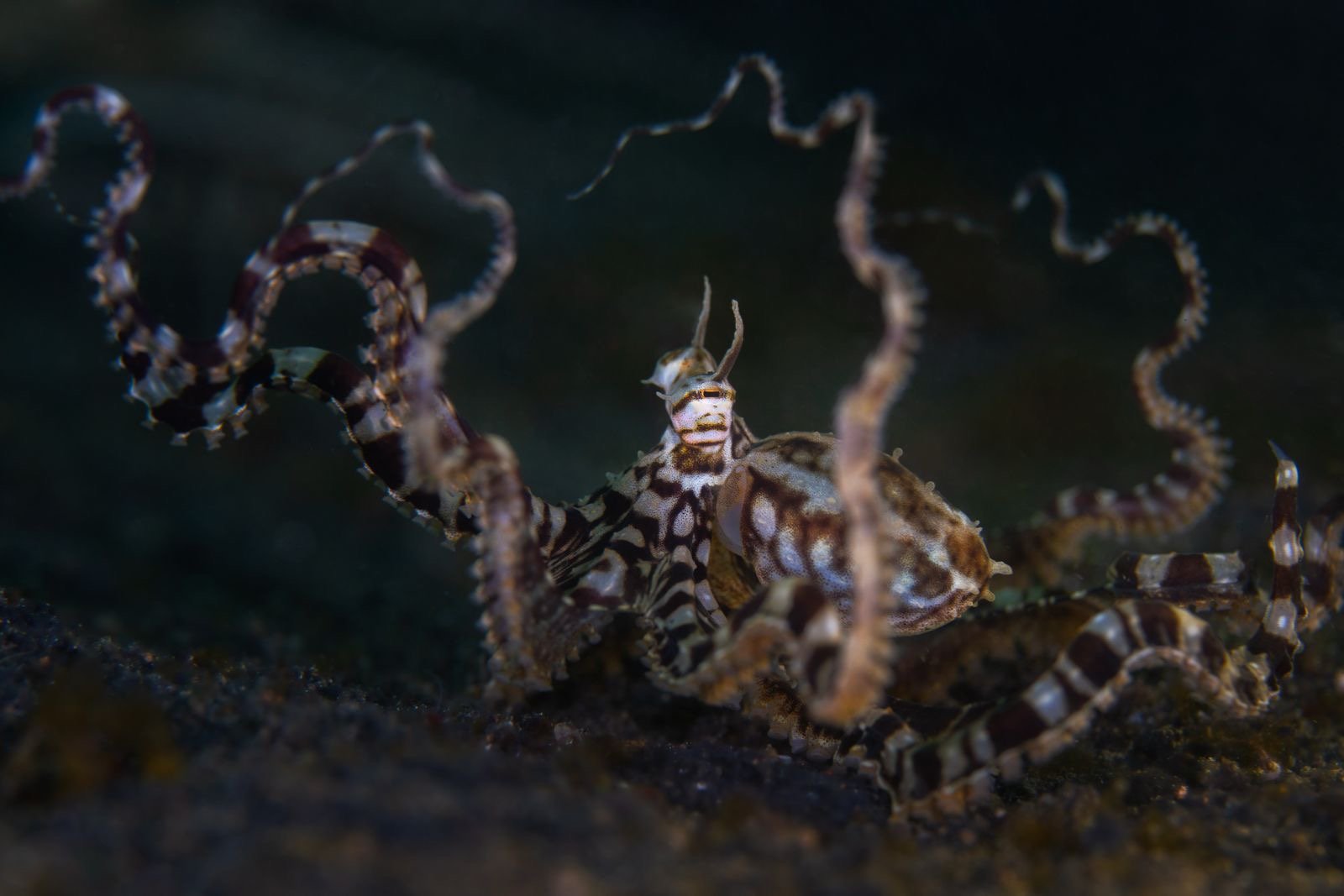
A spectacular mimic octopus (Thaumoctopus mimicus) showing off its incredibly long, beautifully patterned arms against the dark volcanic sand. One of the ocean’s most fascinating masters of disguise!
Photo courtesy of Byron Conroy
The Coconut Octopus: An Octopus With a Portable House
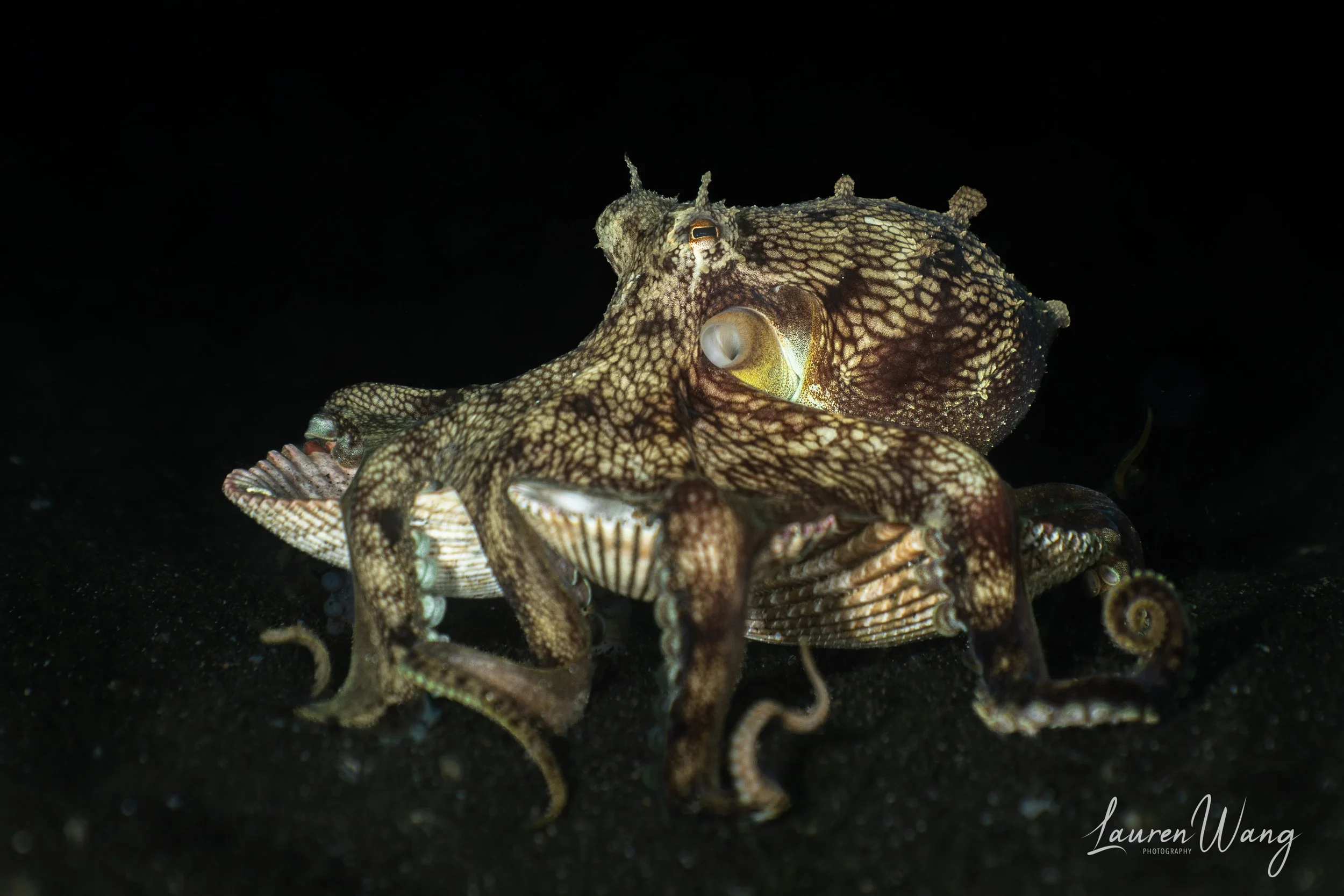
A coconut octopus (Amphioctopus marginatus) stilt-walking across the sand with its shells in tow! I absolutely love this behavior. These clever little octopuses actually carry shells around to use as shelter when they need it. Basically, a tiny octopus bringing its house along for the adventure!
Photo courtesy of Lauren Wang
One of my favorite species that I saw in Lembeh was the coconut octopus, Amphioctopus marginatus, also known as the veined octopus. This relatively small species inhabits sandy and muddy environments across parts of the Indo-Pacific, where suitable hiding places can be limited. Coconut octopuses are resourceful when it comes to finding shelter, often using shells and other hollow objects to protect their soft bodies. However, their most famous behavior goes well beyond simply finding somewhere to hide.
In 2009, researchers published observations of coconut octopuses collecting coconut shell halves, carrying them across the seafloor, and assembling them into protective shelters when needed. The behavior was described as defensive tool use because the animals transported the shells for later use rather than simply occupying them where they were found. Carrying a shell across the sand provides little immediate protection and can make moving around more difficult. The benefit comes later, when the octopus uses the transported pieces to create a shelter.
The way they carry those shells is almost as entertaining as the behavior itself. Researchers documented coconut octopuses moving across the seafloor in an awkward form of locomotion they called stilt-walking, using their arms to maneuver while holding the shells beneath their bodies. Picture a little octopus struggling across the sand with the equivalent of a portable apartment tucked underneath it. Considering how flexible and graceful octopuses usually appear, watching one transport its own building materials is pretty amusing.
What makes this discovery particularly important is that the animals aren't simply responding to an object they happen to encounter. They're collecting and transporting something that can be useful in a different location or at a later time. Tool use has been studied extensively in animals such as chimpanzees, crows, and dolphins, but the coconut octopus provides a fascinating example from an invertebrate. Their behavior doesn't mean they think exactly like humans, but it demonstrates how sophisticated interactions with objects can evolve in animals with very different nervous systems.
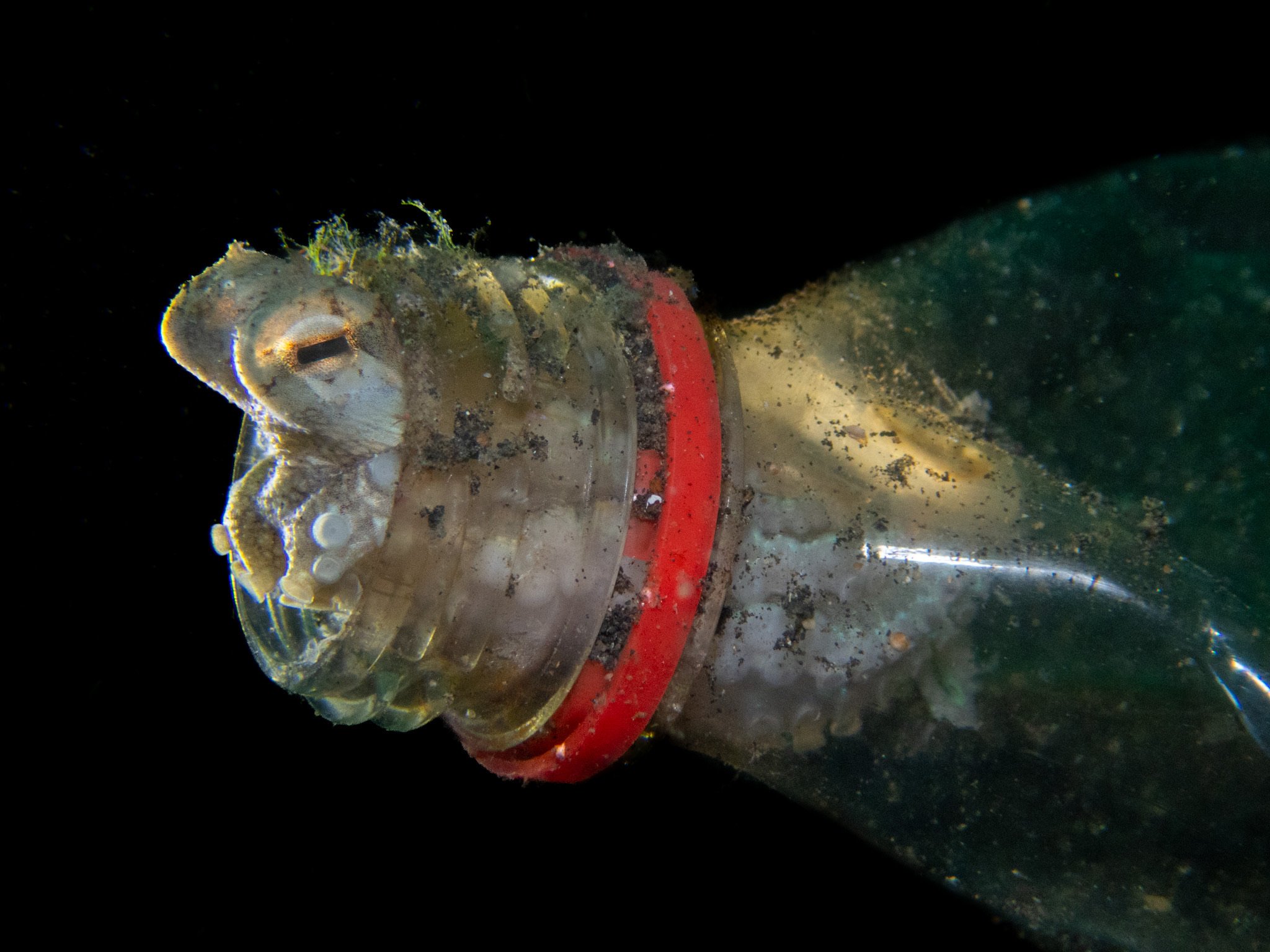
Coconut octopuses have also been observed using other available objects for shelter, including discarded bottles and containers. Their ability to take advantage of different structures is impressive, although finding an octopus living inside human debris is also a reminder of how much trash ends up in the ocean. As much as I enjoy seeing their resourcefulness, I would much rather watch one using natural materials than navigating our pollution.
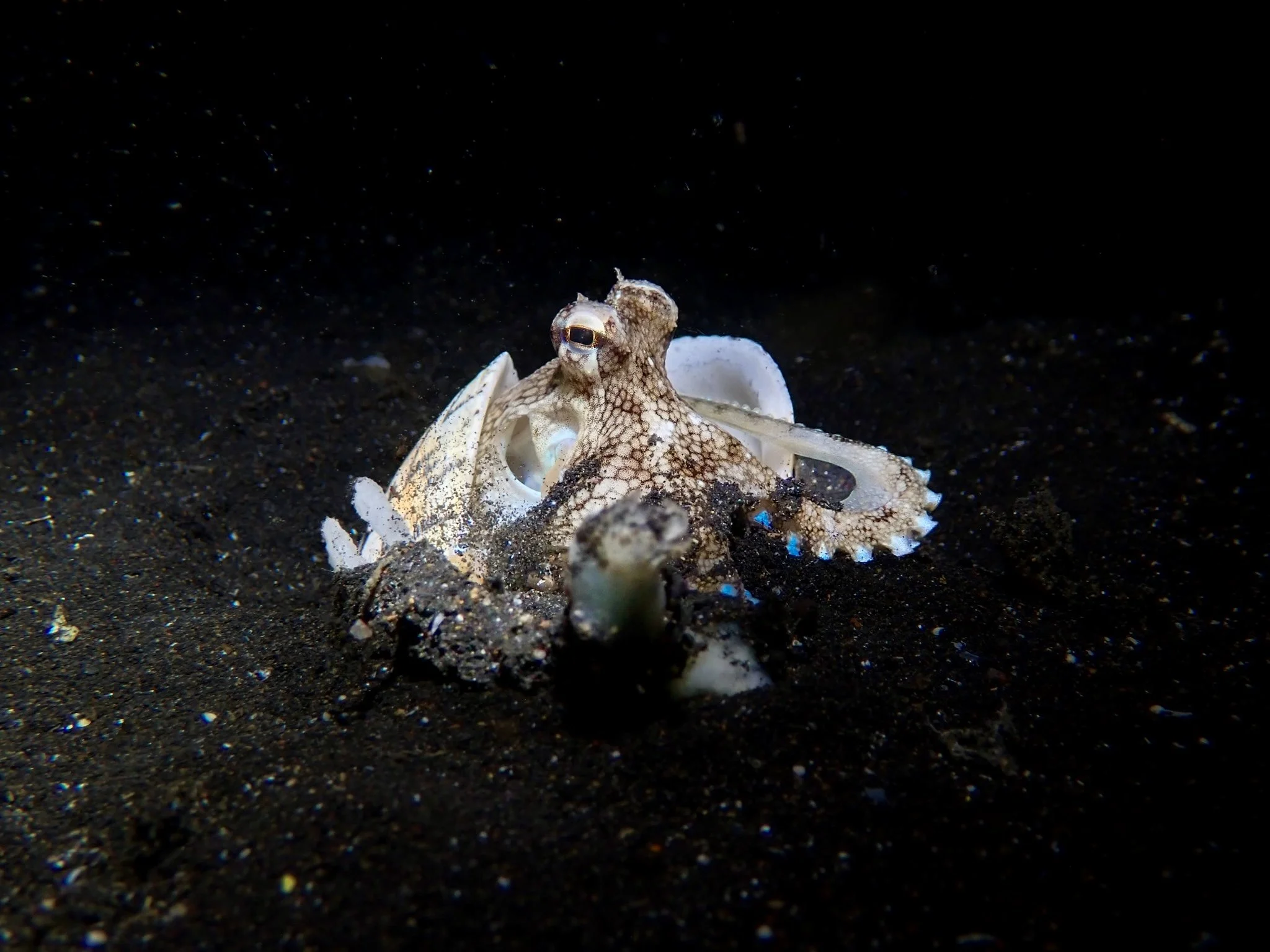
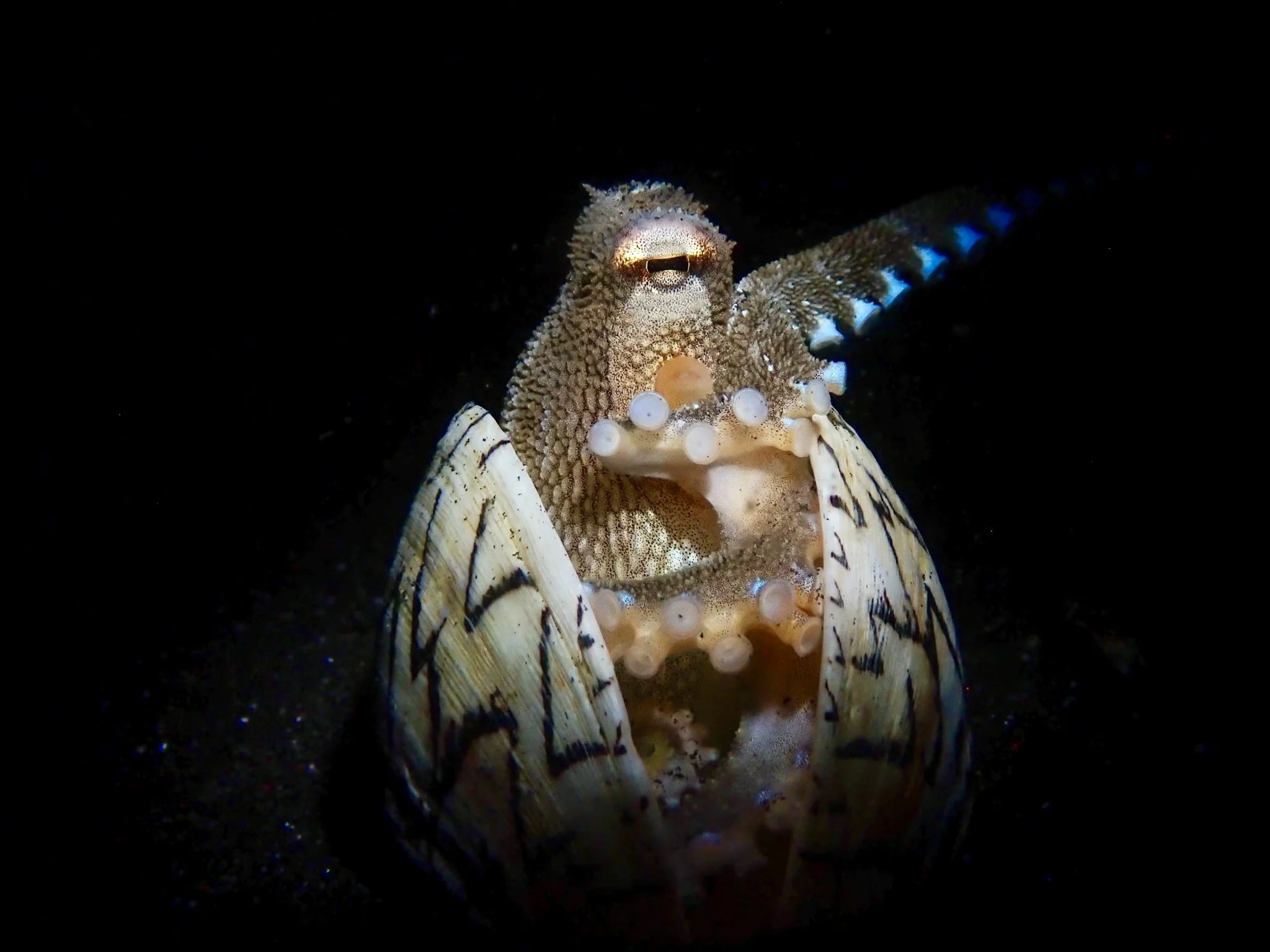
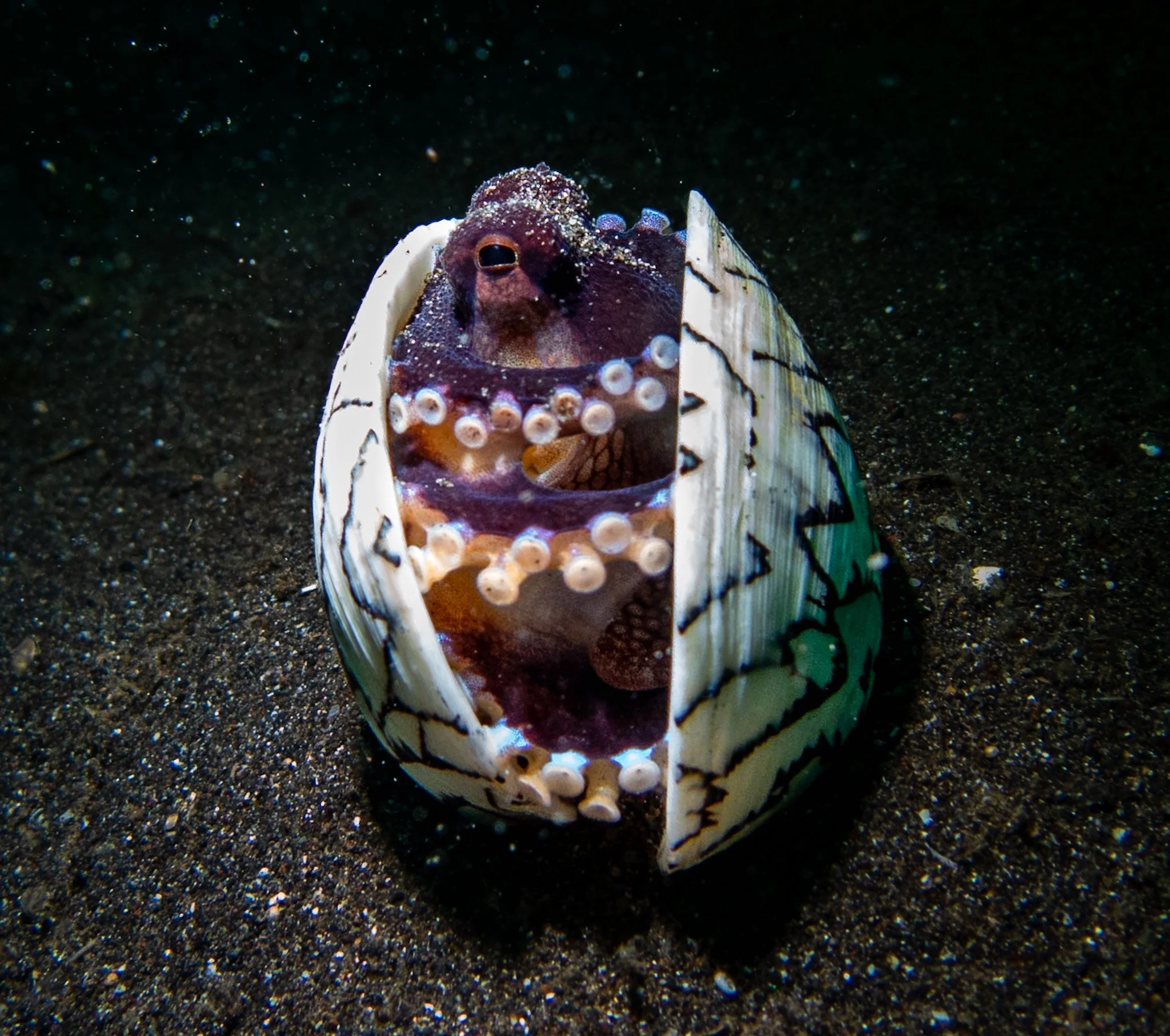
Just a few coconut octopuses (Amphioctopus marginatus) living their best lives in Lembeh, Indonesia! 🐙 From carrying shells around to finding the perfect little hiding spot, these clever octopuses are endlessly entertaining to watch.
The Mimic Octopus: An Underwater Impersonator
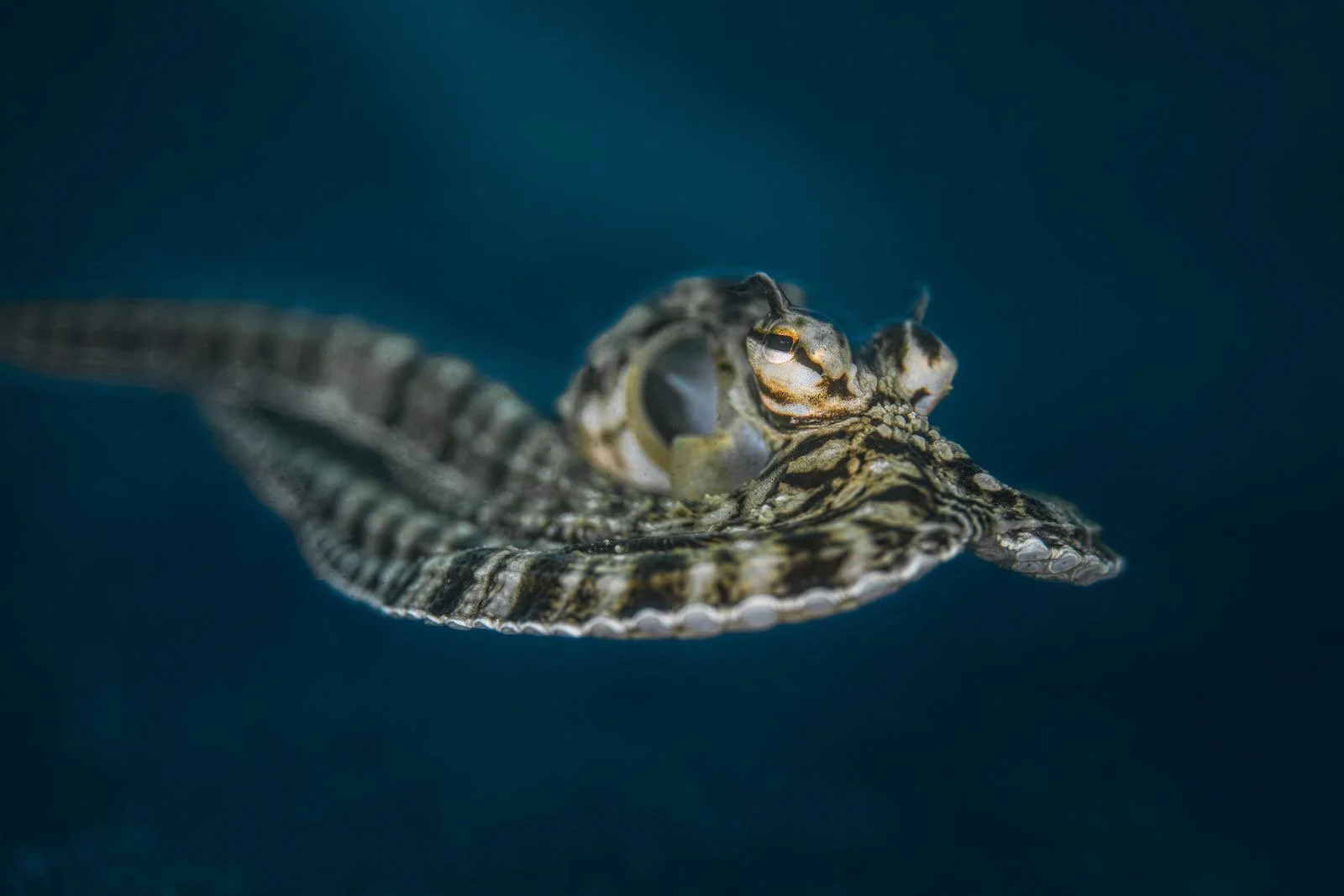
A mimic octopus (Thaumoctopus mimicus) in action, flattening its body and extending its arms into a shape resembling a flatfish! This remarkable behavior is one of the reasons these octopuses are considered some of the ocean’s most fascinating masters of disguise.
Photo courtesy of Byron Conroy
The mimic octopus, Thaumoctopus mimicus, is another remarkable resident of the sandy environments around Lembeh. Formally described in 2005, this long-armed species is particularly famous for its ability to change not only its color and appearance but also the way it moves. Researchers have documented several unusual postures and swimming behaviors, some of which resemble other marine animals. Their flexibility makes them especially fascinating to observe because the same octopus can look dramatically different depending on what it's doing.
One of the best-documented examples involves the mimic octopus flattening its body, extending its arms, and swimming close to the seafloor in a way that resembles a flatfish. Other displays have been interpreted as resembling sea snakes and potentially dangerous marine animals, although scientists continue to investigate the exact functions of those behaviors. Resembling another animal isn't automatically proof that predators are being deceived, so it's important to distinguish what researchers have observed from what those displays might accomplish. Even with that distinction, an octopus capable of changing its posture and swimming style so dramatically is pretty incredible.
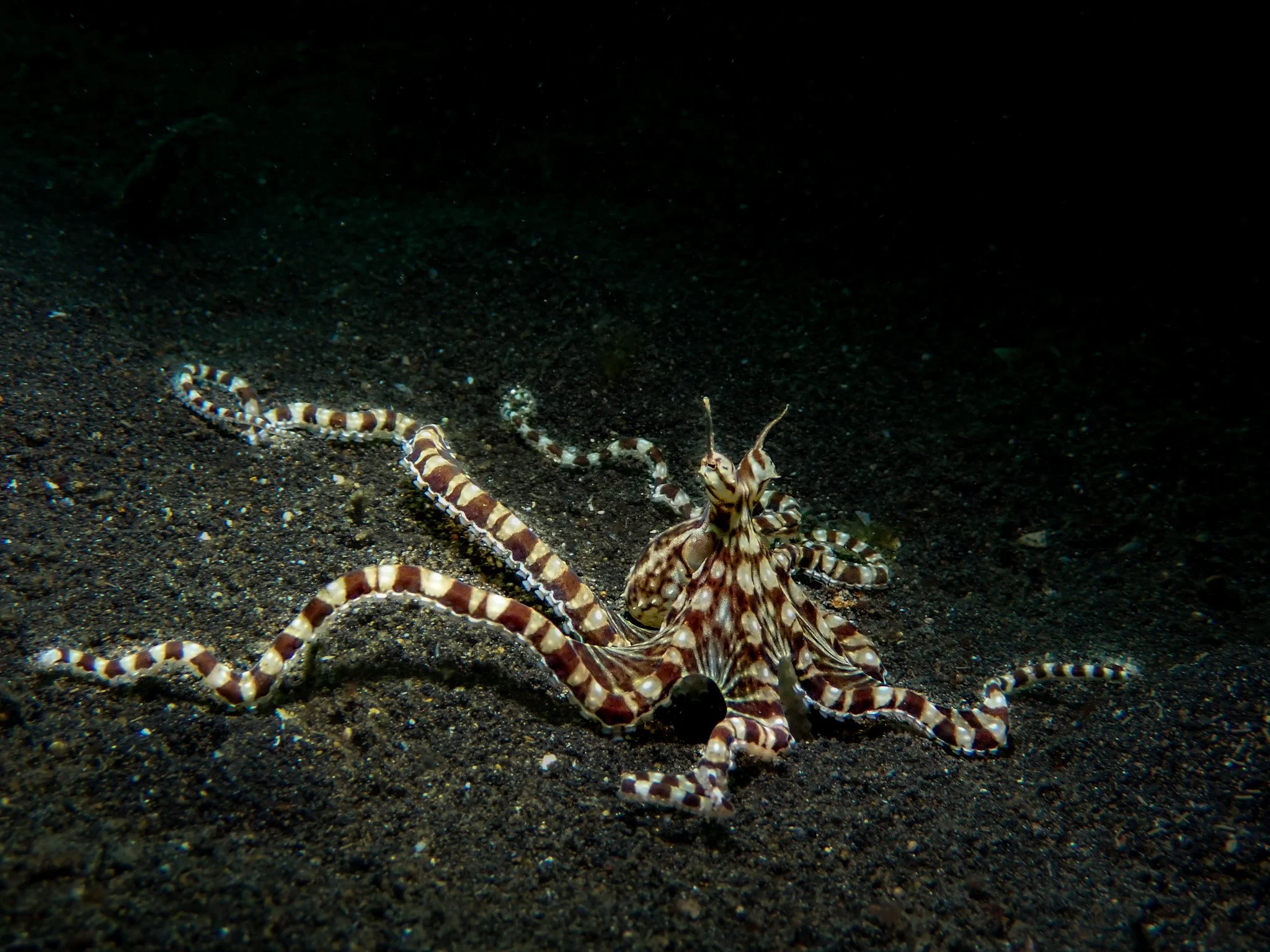
A mimic octopus (Thaumoctopus mimicus) spotted in Lembeh, Indonesia, just moments before it seemingly vanished into the sand. One of the ocean’s most impressive masters of disguise!
Mimic octopuses are frequently confused with the wunderpus, another long-armed species found in similar habitats. Both have striking markings and can appear somewhat similar when partially concealed in the sand. Their differences become more apparent when you examine their body proportions, markings, and eye structures. Seeing both species during our Lembeh trip was a wonderful reminder that even closely resembling octopuses can have distinct adaptations and behaviors.
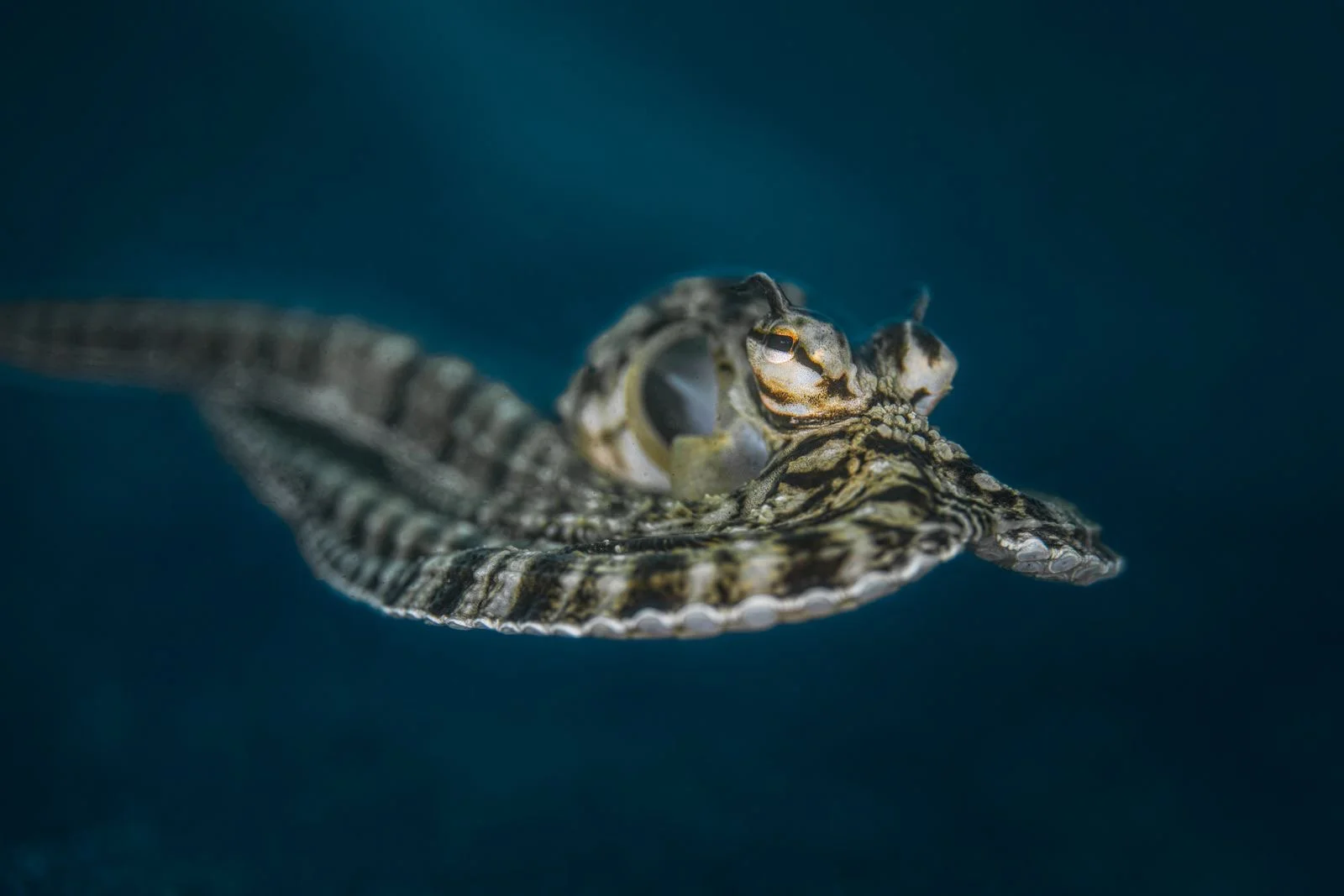
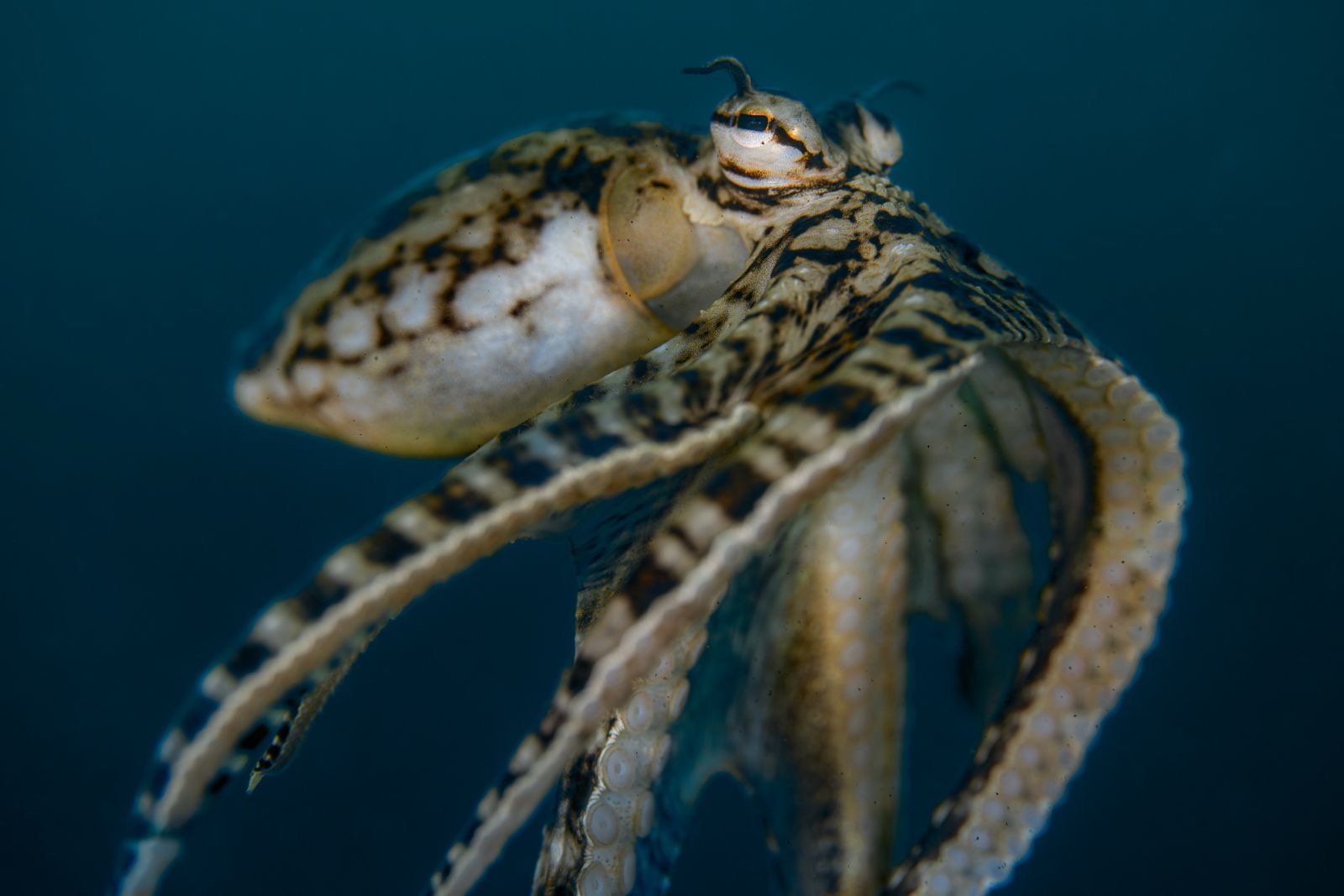
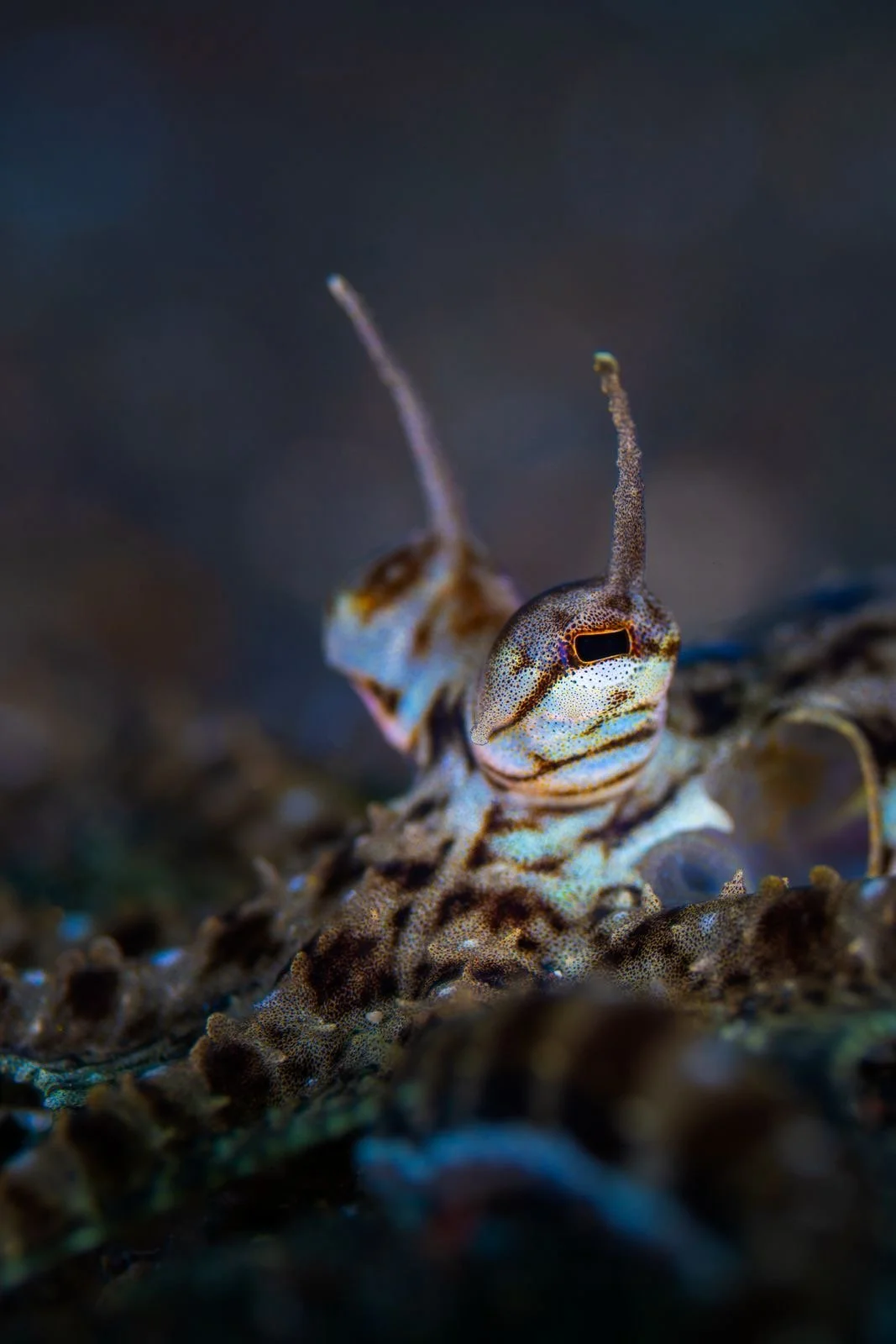
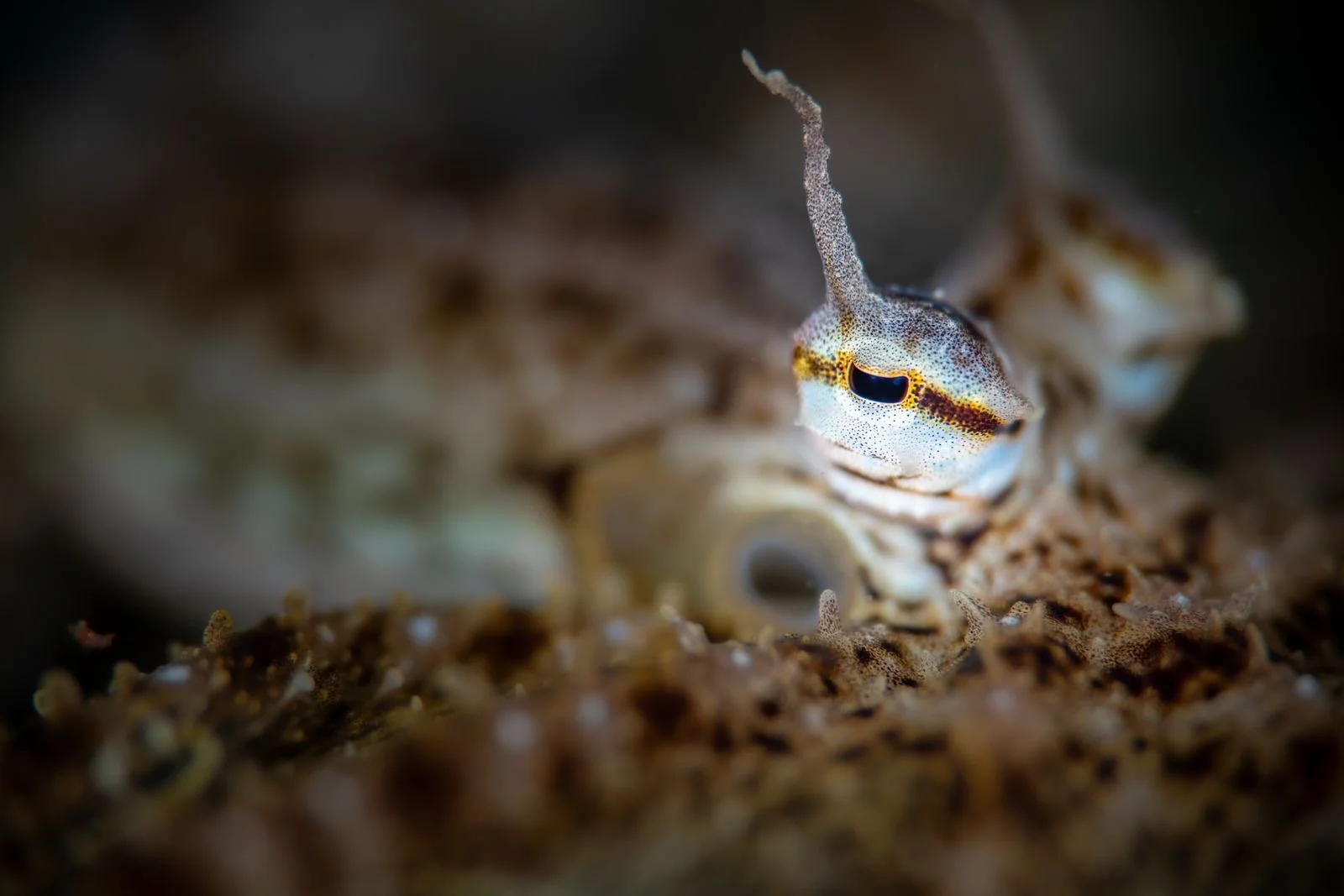
Take a look at this incredible gallery of mimic octopus photographs by underwater photographer Byron Conroy, showcasing one of the ocean’s most fascinating masters of disguise.
The Wunderpus: A Very Photogenic Octopus
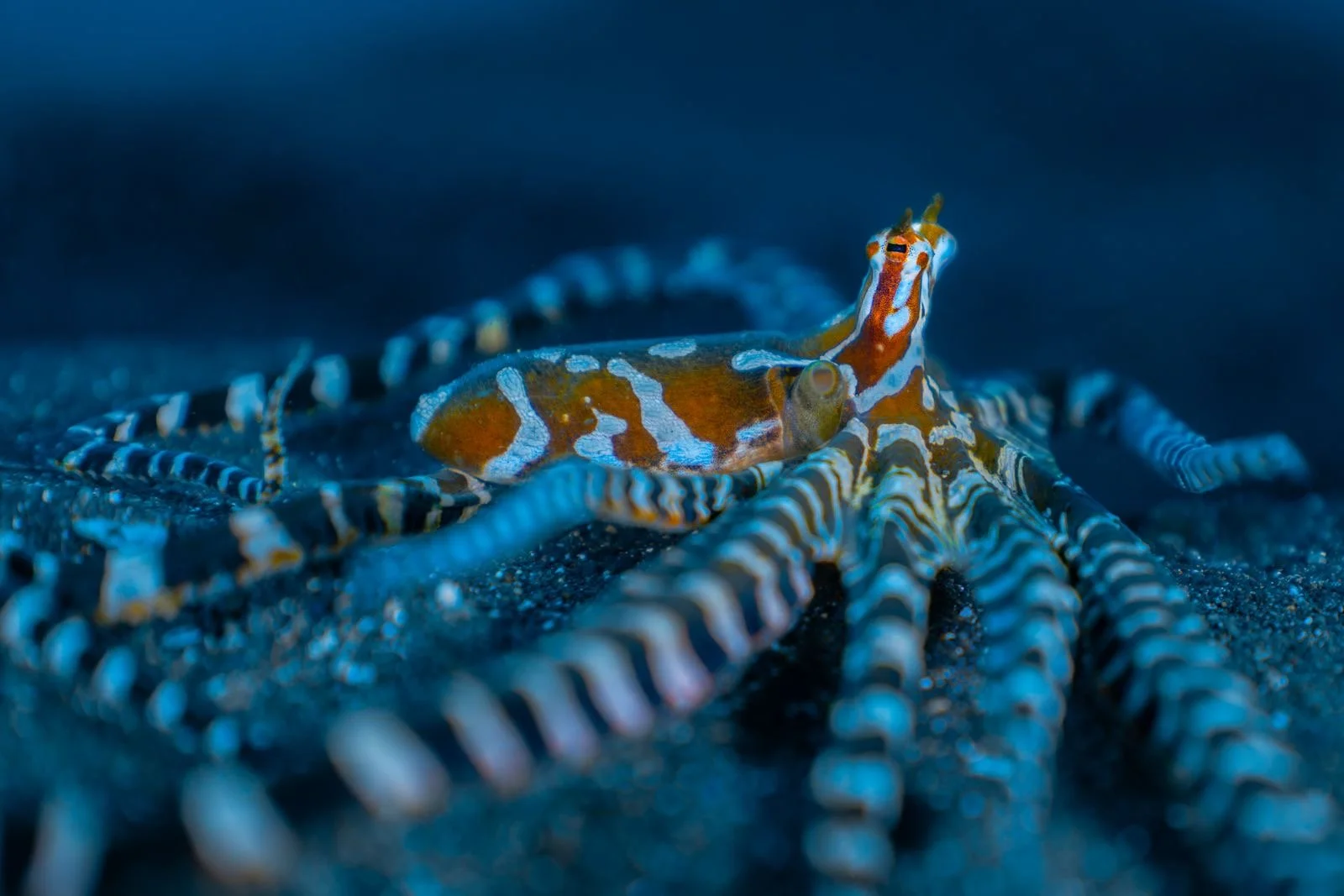
The wonderfully photogenic wunderpus octopus (Wunderpus photogenicus), with its striking white markings, reddish-brown body, and incredibly long arms. Photo courtesy of Byron Conroy
The wunderpus, Wunderpus photogenicus, might have one of my favorite scientific names in the ocean. With its reddish-brown body, contrasting white markings, exceptionally long arms, and eyes perched on raised stalks, this octopus looks like someone decided an ordinary octopus wasn't quite dramatic enough. The species was formally described in 2006, although divers and researchers had encountered it before receiving its scientific name. As an underwater photographer, I can certainly appreciate a species with photogenicus in its name.
Wunderpus octopuses are frequently confused with mimic octopuses, Thaumoctopus mimicus, and it's easy to understand why. Both inhabit sandy and muddy environments in the Indo-Pacific, have exceptionally long arms, and display contrasting light and dark markings. However, there are some useful differences to look for when trying to identify them underwater. The wunderpus typically has a reddish-brown background with distinct white spots and bands, while the mimic octopus often displays more continuous pale stripes along its arms and can change its overall appearance considerably. Wunderpus octopuses also tend to have more prominent, elongated eye stalks, although appearance alone isn't always enough for a confident identification.
Their behaviors can provide additional clues, but neither species is limited to one particular movement or posture. Mimic octopuses are especially famous for adopting postures and swimming styles resembling other marine animals, including flatfish. Wunderpus octopuses also change their appearance and use their long arms to explore the seafloor, so a single pose isn't necessarily enough to tell the two apart. For underwater photographers, getting a clear view of the mantle, eyes, and arm markings can be particularly helpful when reviewing photographs after a dive.
One of the coolest scientific discoveries about the wunderpus came in 2008, when researchers demonstrated that individual animals could be identified using the arrangement of white markings on their mantles. These patterns can be sufficiently distinctive and consistent to help researchers recognize the same animal across different photographs. The findings suggested that photo identification could provide a useful, noninvasive way to study wild populations without physically marking or capturing individuals. I love this connection to underwater photography because it reminds me of how researchers identify manta rays using their unique belly markings. A photograph can be more than a beautiful image; with the right information, it can also contribute to scientific research.
Seeing both mimic and wunderpus octopuses during our trip to Lembeh was particularly exciting because it gave us the chance to appreciate two animals that look similar at first glance but have their own distinctive characteristics. These are exactly the kinds of encounters that make muck diving so rewarding. A patch of sand that might look completely unremarkable can be home to an animal with extraordinary adaptations, fascinating behavior, and a surprising amount of scientific research behind it.
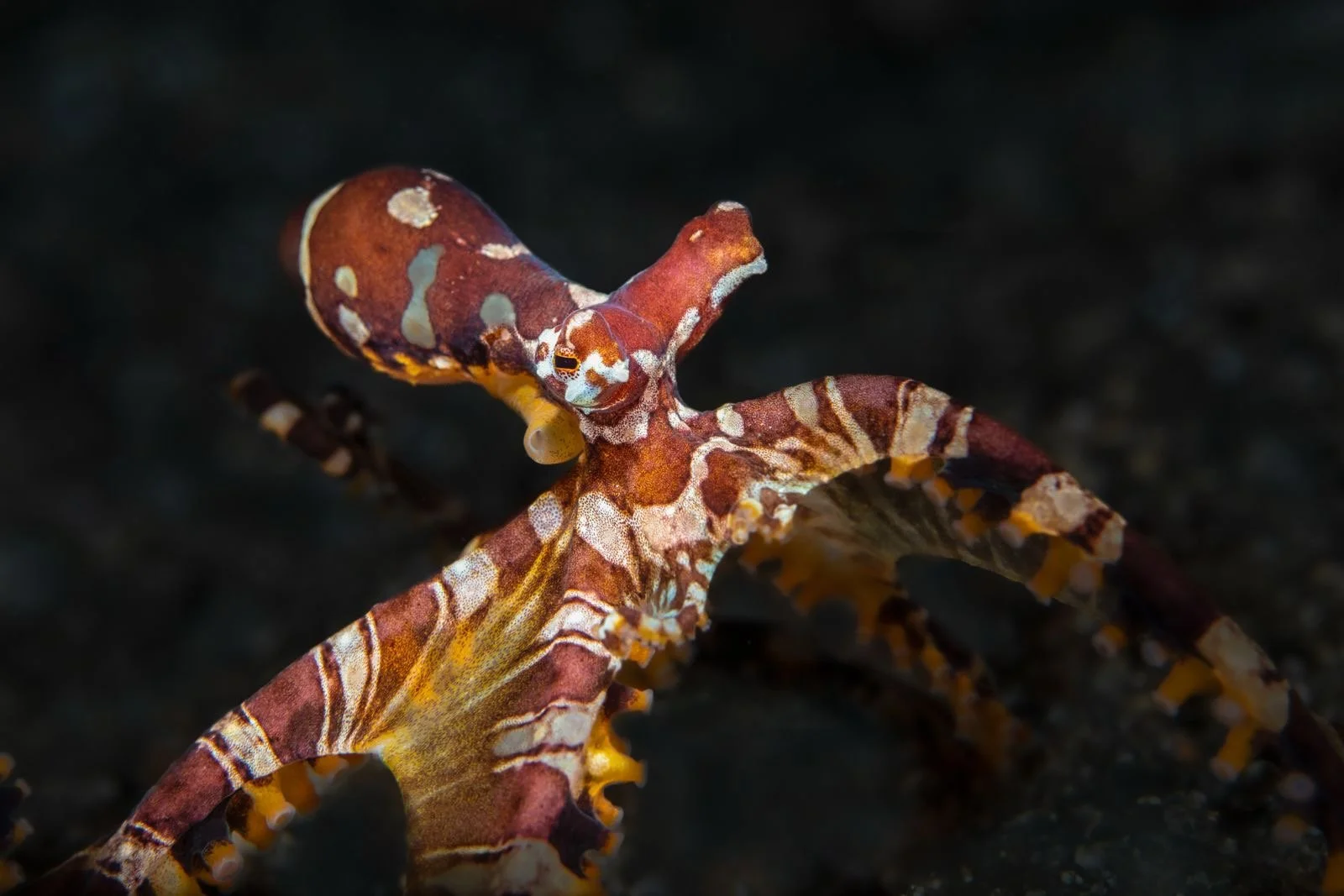
A stunning wunderpus octopus (Wunderpus photogenicus) showing off its rich reddish-brown colors, striking white markings, and beautifully patterned arms. With a scientific name like photogenicus, it's certainly living up to its reputation!
Photo courtesy of Byron Conroy.
The Giant Pacific Octopus: Big, Brilliant, and Surprisingly Elusive
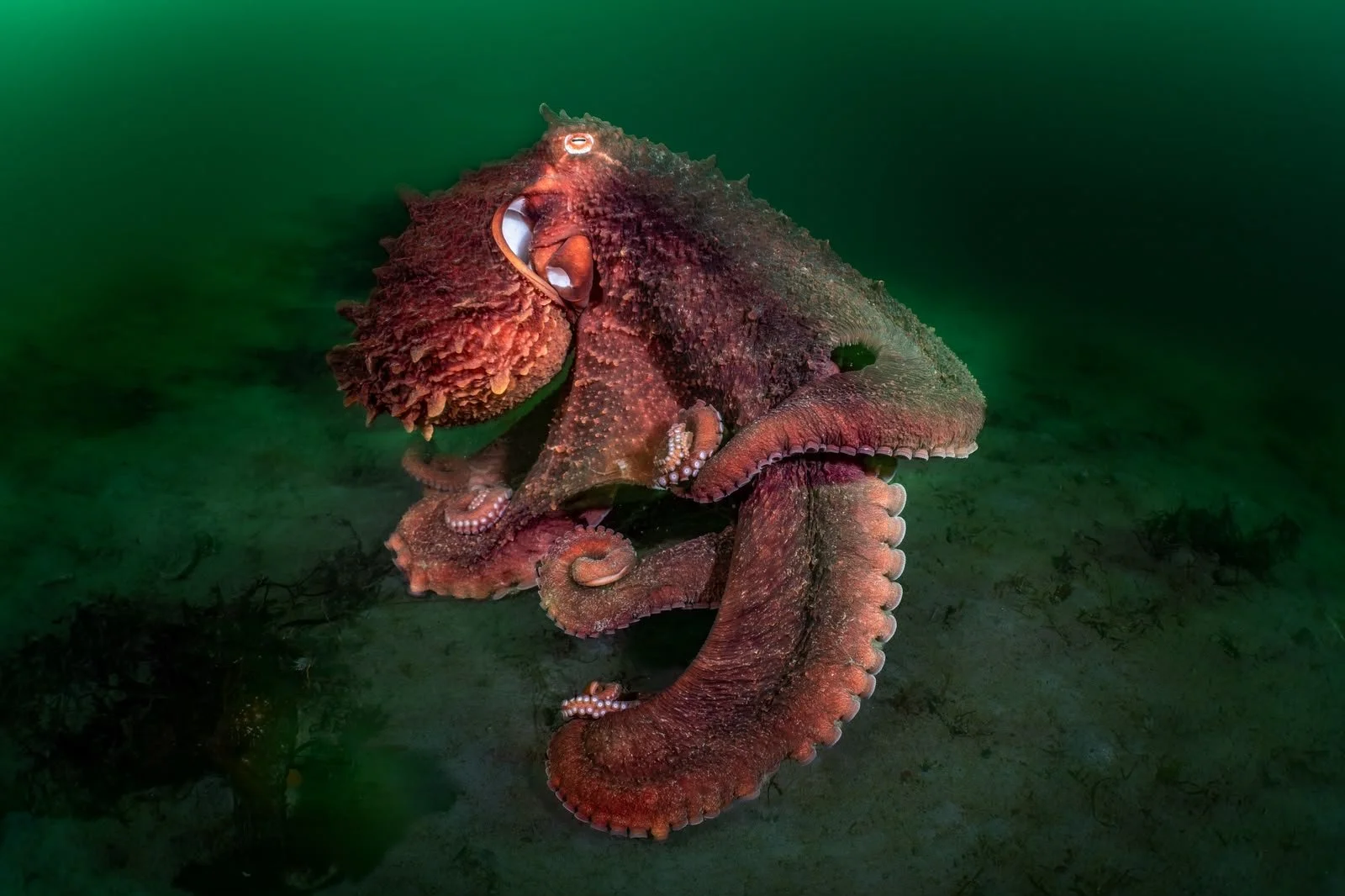
A magnificent male giant Pacific octopus (Enteroctopus dofleini) photographed off Vancouver Island, British Columbia. The largest living octopus species!
Photo courtesy of Byron Conroy
Of all the octopuses in the ocean, there's one I still dream about encountering in the wild: the giant Pacific octopus (Enteroctopus dofleini). Found in the colder waters of the North Pacific, this is generally considered the largest living octopus species. Adults can weigh around 20 to 50 pounds (9 to 23 kg), with arm spans reaching approximately 10 to 16 feet (3 to 5 meters). Some exceptional individuals grow even larger! Just imagine coming across an octopus whose arms could stretch farther than you are tall!
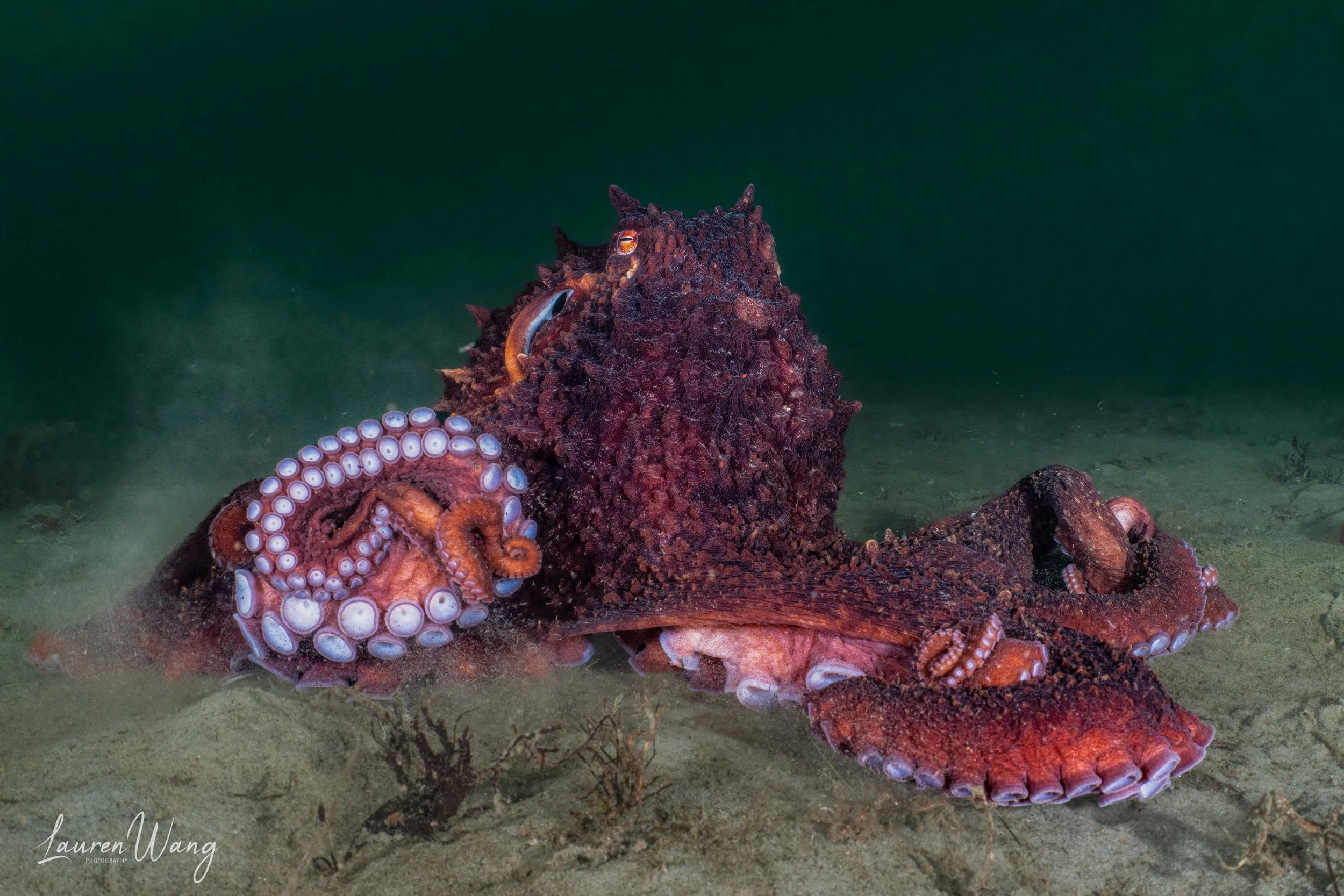
Look at that incredible texture! A giant Pacific octopus (Enteroctopus dofleini) showing off its gorgeous reddish coloring and bumpy skin.
Photo courtesy of Lauren Wang
Despite their impressive size, giant Pacific octopuses are surprisingly good at disappearing. They can rapidly change their colors, patterns, and skin textures to blend into rocky reefs, squeezing into crevices that seem far too small for their enormous bodies. Their eight arms are lined with powerful suckers that help them explore their surroundings, manipulate objects, and capture prey such as crabs and clams. They're also remarkably intelligent, with documented abilities to solve puzzles, open containers, and learn through experience. The idea that an animal this large can be both incredibly strong and so skilled at camouflage is fascinating to me.
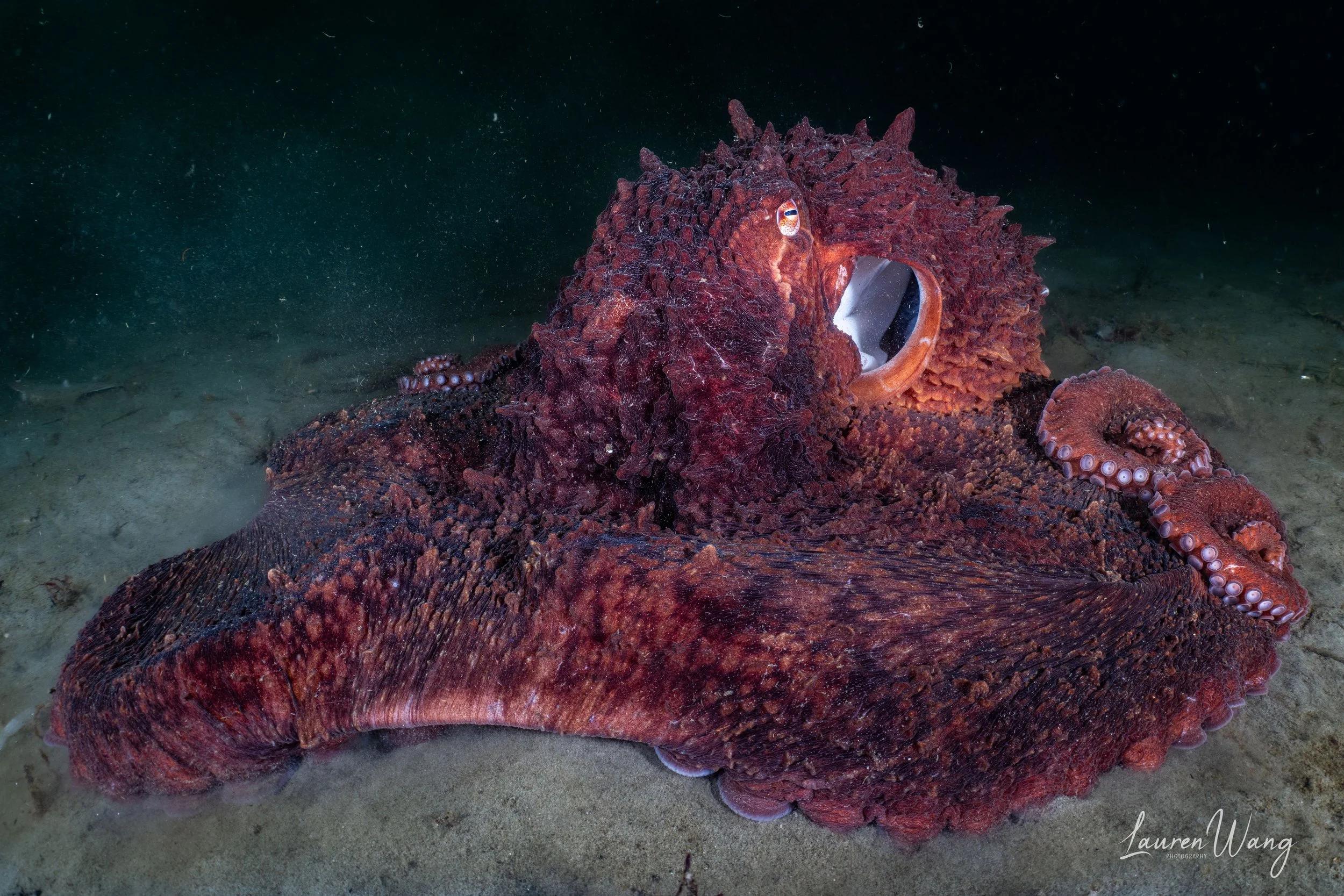
Those incredible textures and that gorgeous deep red! Lauren Wang captured every little detail of this giant Pacific octopus (Enteroctopus dofleini) off Vancouver Island.
Photo courtesy of Lauren Wang
Like most octopuses, giant Pacific octopuses have a fascinating but bittersweet life cycle. Females can lay tens of thousands of eggs, spending months carefully guarding and cleaning them while circulating fresh, oxygen-rich water over them. During this time, they typically stop eating, dedicating the remainder of their lives to protecting their developing young. Once the eggs hatch, the mother dies. What's especially remarkable to me is that an animal capable of growing to such an enormous size generally lives just three to five years. That's a lot of growing, exploring, and surviving packed into a relatively short life!
I have to give a little shoutout to underwater photography power couple Lauren Wang and Byron Conroy! While diving together off Vancouver Island, Canada, Lauren spotted a giant Pacific octopus, and both captured some incredible photographs of the encounter. Can you imagine the excitement of finding one of these giants?! I love that they get to share adventures like this together!
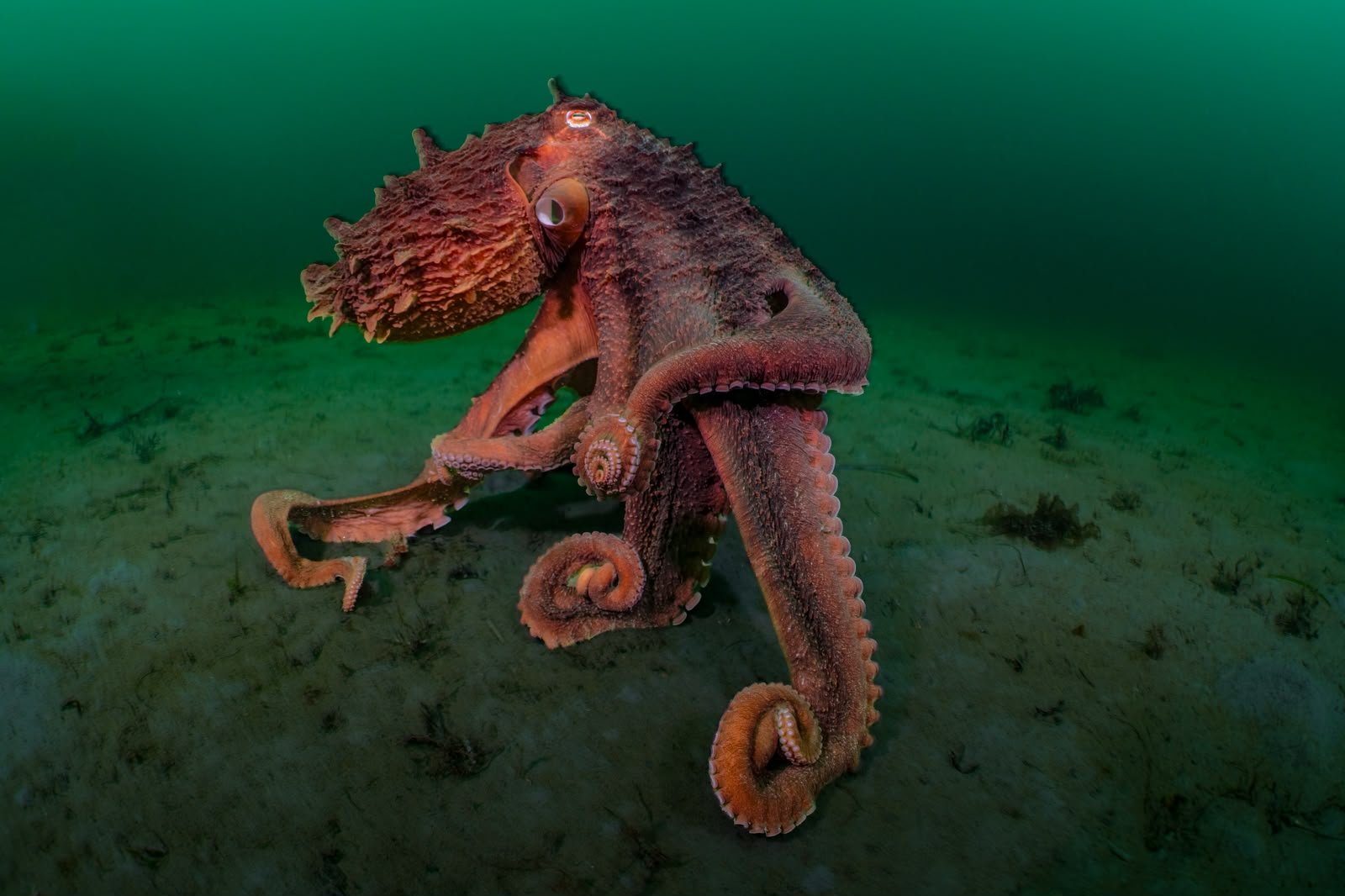
The same male giant Pacific octopus (Enteroctopus dofleini) making his way across the seafloor off Vancouver Island, British Columbia.
Photo courtesy of Byron Conroy
The Mototi Octopus: Little Octopus, Big Personality
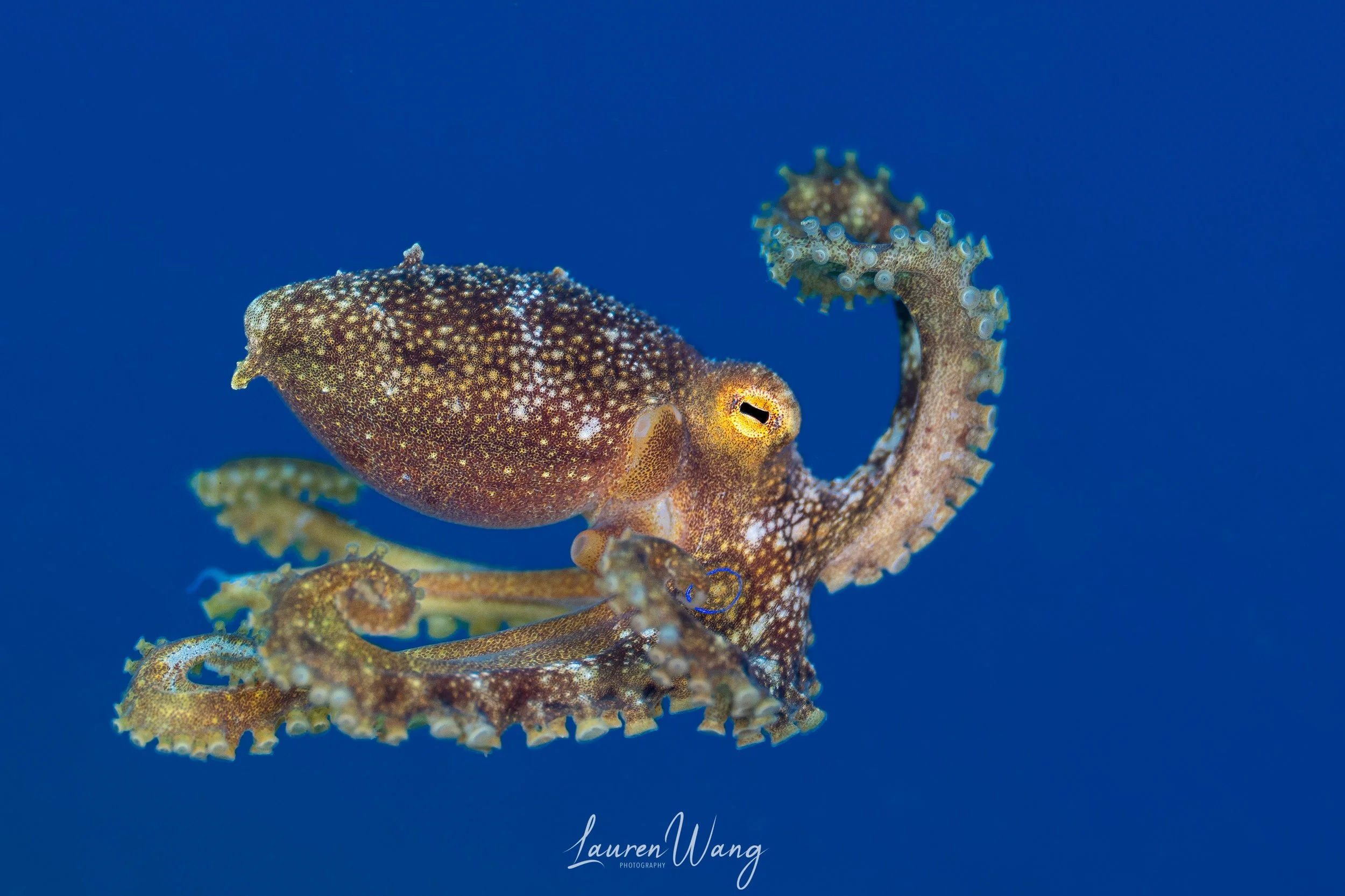
A mototi octopus (Amphioctopus mototi) showing off its beautiful colors, curled arms, and one of its distinctive blue-ringed eyespots. I love how Lauren captured all those tiny details against the blue background!
Photo courtesy of Lauren Wang
Another fascinating species we encountered in Lembeh was the mototi octopus, Amphioctopus mototi, sometimes called the poison ocellate octopus. This species has two distinctive false eyespots, or ocelli, that can display vivid blue rings surrounded by darker pigmentation. The markings are particularly noticeable when the animal adopts certain defensive appearances, making them useful identification features. Mototi octopuses can also vary considerably in their overall coloration and pattern.
Those blue eyespots sometimes cause confusion with blue-ringed octopuses, but they're different animals. Mototi octopuses have two prominent ocelli, whereas blue-ringed octopuses typically display multiple iridescent blue rings or lines across their bodies and arms. The mototi's eyespots are believed to play a role in defensive signaling, although their precise effects on predators are not fully understood. I find the distinction especially interesting because similar-looking markings can appear in different octopus species without necessarily serving identical functions.
Like other octopuses, mototi octopuses possess venom used in feeding, but the presence of blue markings alone doesn't establish that their venom has the same composition or medical significance as that of blue-ringed octopuses. Their appearance is more than enough reason to appreciate them without handling or disturbing them. An encounter with a mototi is exciting precisely because we get to observe such an unusual animal behaving naturally.
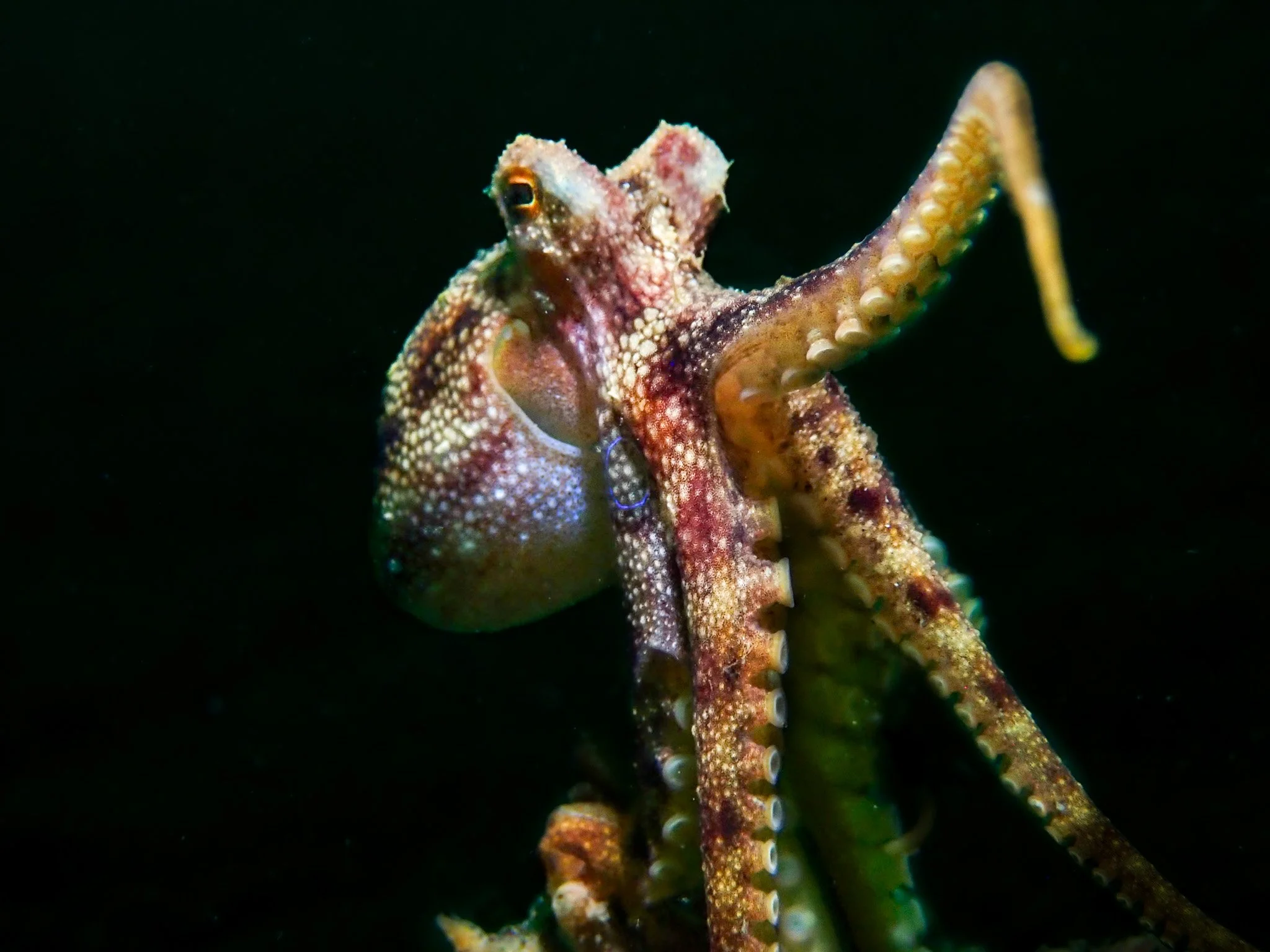
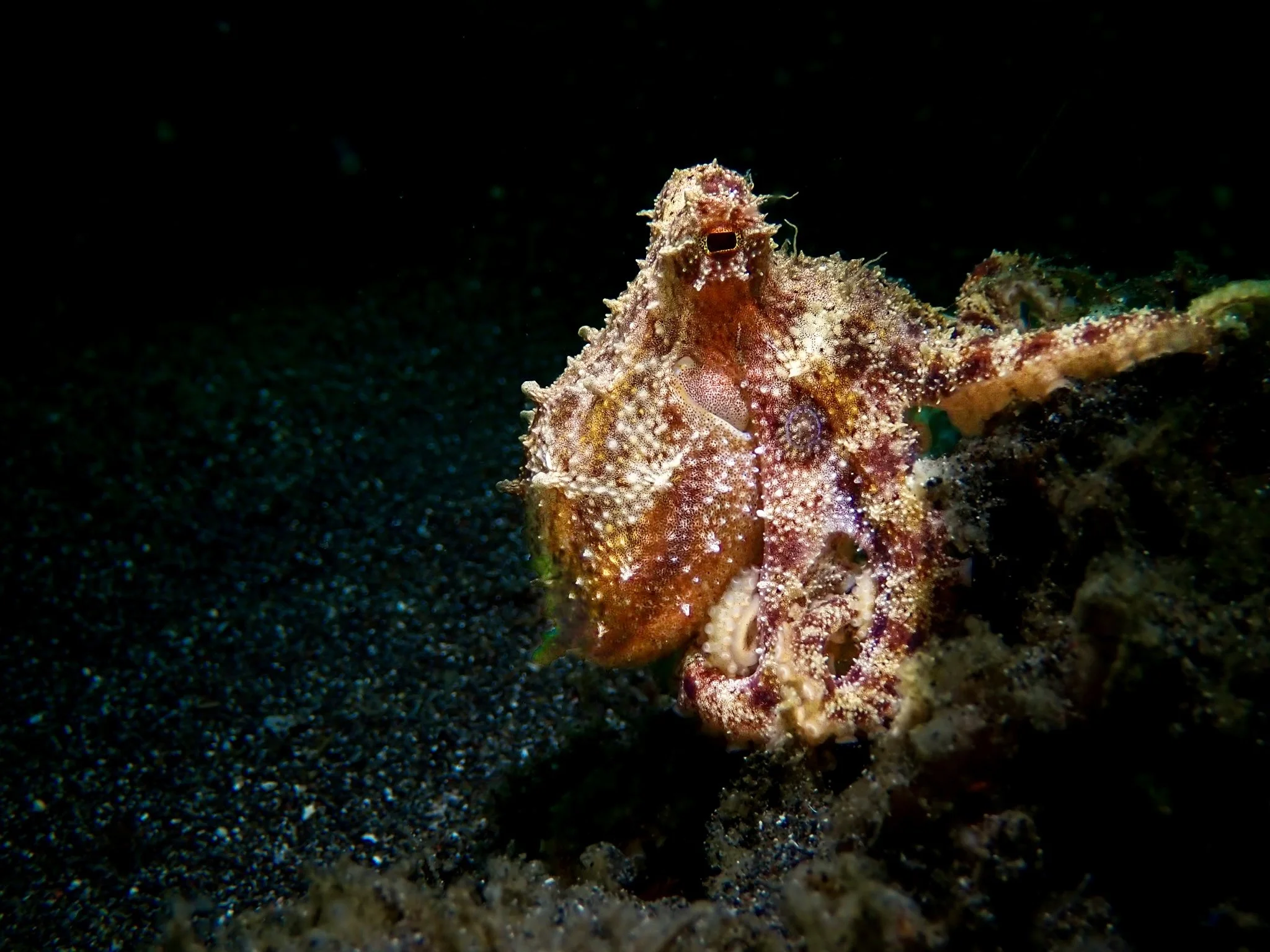
This curious little mototi octopus (Amphioctopus mototi) in Lembeh apparently decided my camera was worth investigating! It even reached out and tried to grab it. Not quite the photo opportunity I was expecting, but definitely a memorable encounter!
Blue-Ringed Octopuses: Small, Beautiful, and Best Left Alone
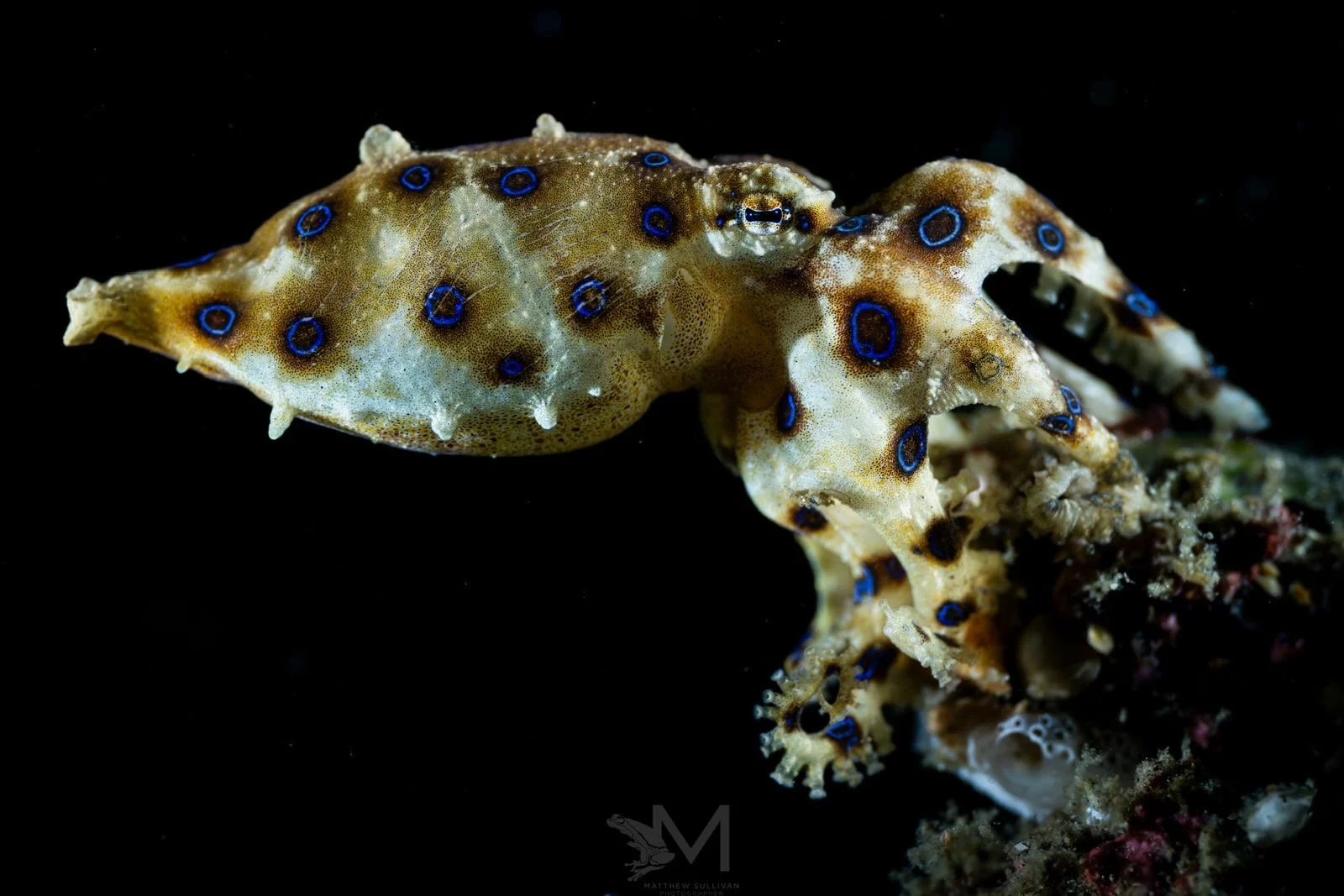
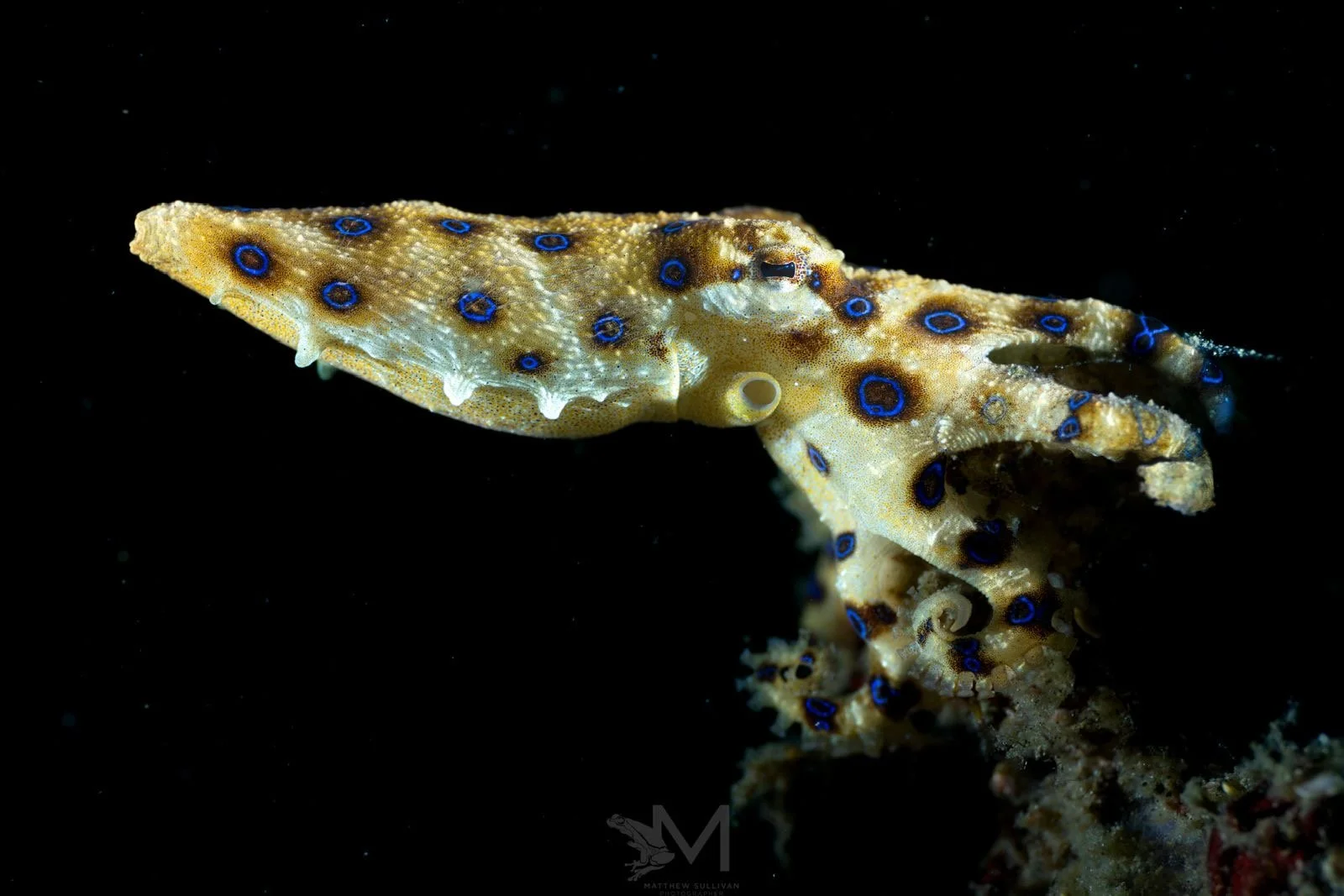
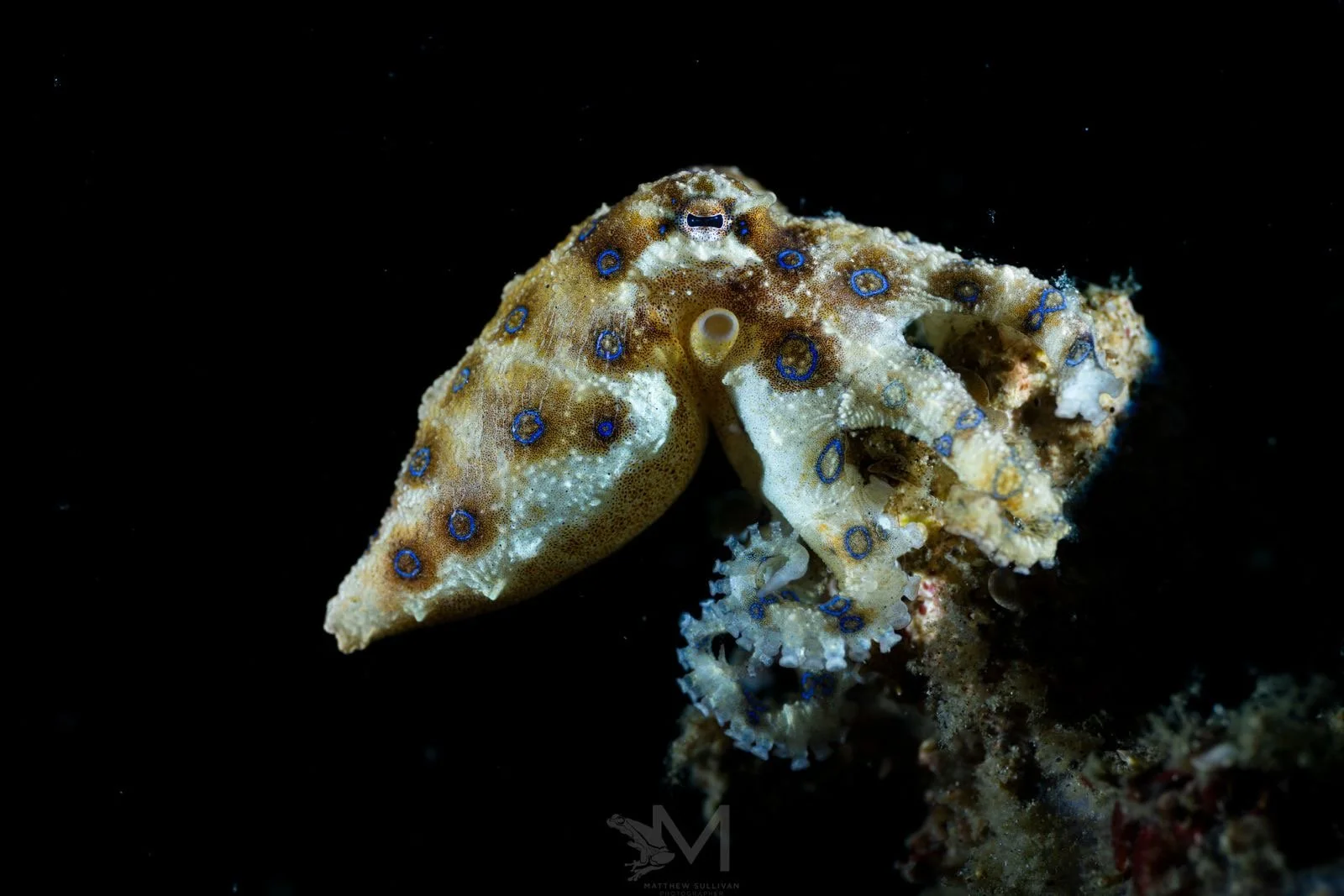
Same blue-ringed octopus, just moments apart. Look at how much its shape and appearance change between these two photos!
Photo courtesy of Matthew Sullivan
Blue-ringed octopuses belong to the genus Hapalochlaena and are among the most recognizable venomous animals in the ocean. What surprised me most when I encountered my first blue-ringed octopus in Lembeh was just how tiny it was! You see these incredible animals in photographs, but it's hard to appreciate their actual size until you find one underwater. Depending on the species, adults can measure roughly 10 to 20 centimeters (4 to 8 inches) across with their arms extended, while their bodies are considerably smaller. I knew they were little, but I genuinely wasn't prepared for just how tiny they could be.
They're also surprisingly quick, which makes photographing them a challenge! Between their small size, incredible camouflage, and ability to dart into nearby hiding places, getting a good photograph requires patience and a little luck. Blue-ringed octopuses can appear surprisingly inconspicuous when resting, often displaying muted brown or yellowish coloration that helps them blend into their surroundings. When threatened or disturbed, their brilliant iridescent blue markings can become much more conspicuous. Those beautiful rings serve as warning signals, not an invitation to get closer.
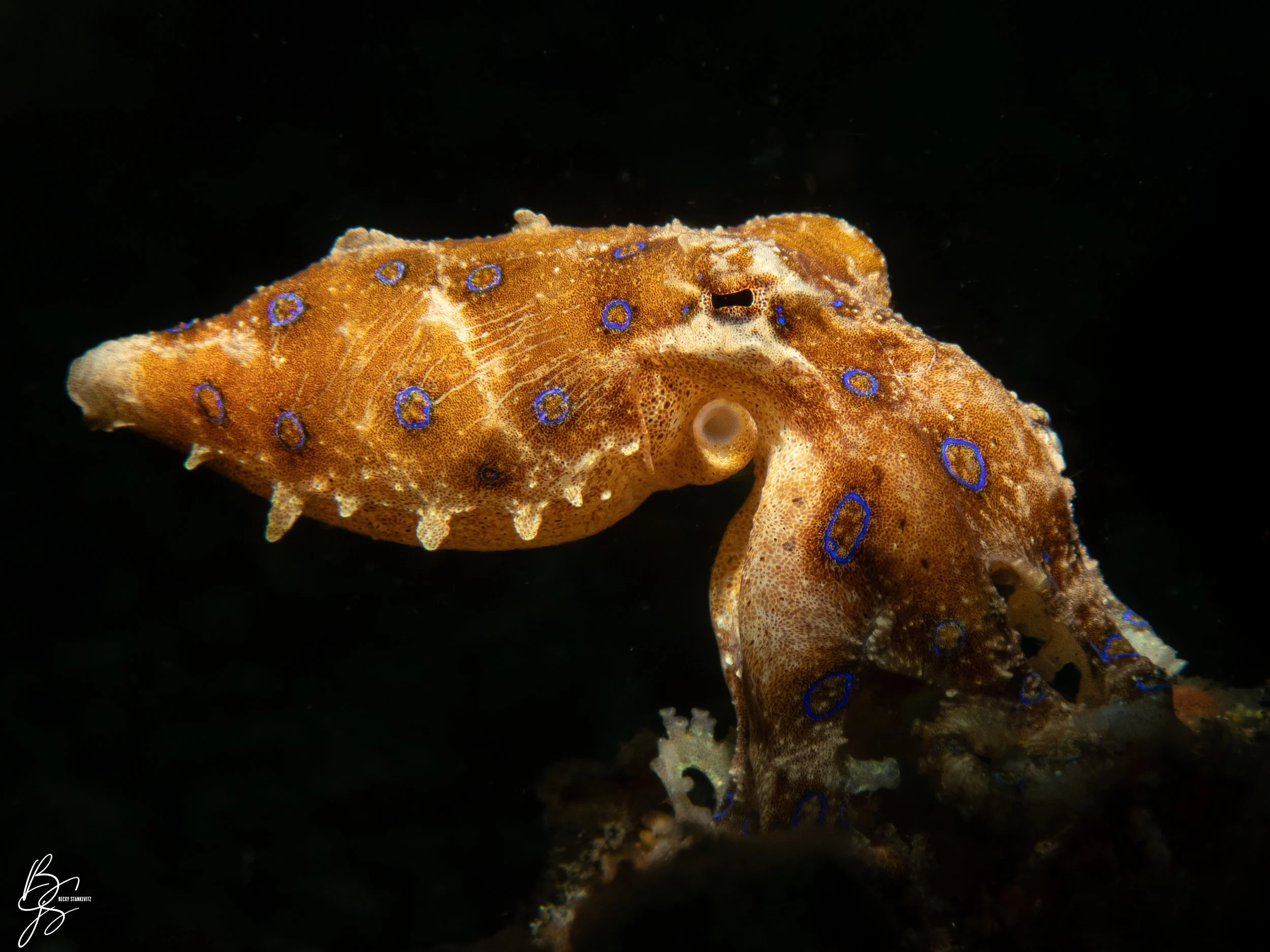
Those blue rings are absolutely stunning! Tiny, gorgeous, and definitely one to admire from a distance!
Photo courtesy of Becky Stankevitz
Despite their tiny size, blue-ringed octopuses possess an incredibly powerful defense. Their venom contains tetrodotoxin, a neurotoxin capable of causing paralysis and potentially fatal respiratory failure in humans. A bite may be nearly painless, but severe envenomation is a medical emergency, and there is currently no specific antivenom. Fortunately, these octopuses generally avoid confrontation when left undisturbed, often retreating into crevices or other hiding places rather than confronting a potential threat. Giving them space and never attempting to touch or handle one are the best ways to enjoy an encounter safely.
One of the most fascinating things about blue-ringed octopuses is how they combine camouflage with such striking warning coloration. An animal that was almost invisible against the seafloor can suddenly reveal brilliant blue markings when threatened. However, those rings aren't something we should deliberately try to trigger for a photograph. Finding my first blue-ringed octopus in Lembeh was such a cool experience. Between their tiny size, incredible camouflage, and how quickly they move, they're certainly not the easiest subjects to photograph! But that's part of what makes encountering these fascinating little octopuses so exciting.
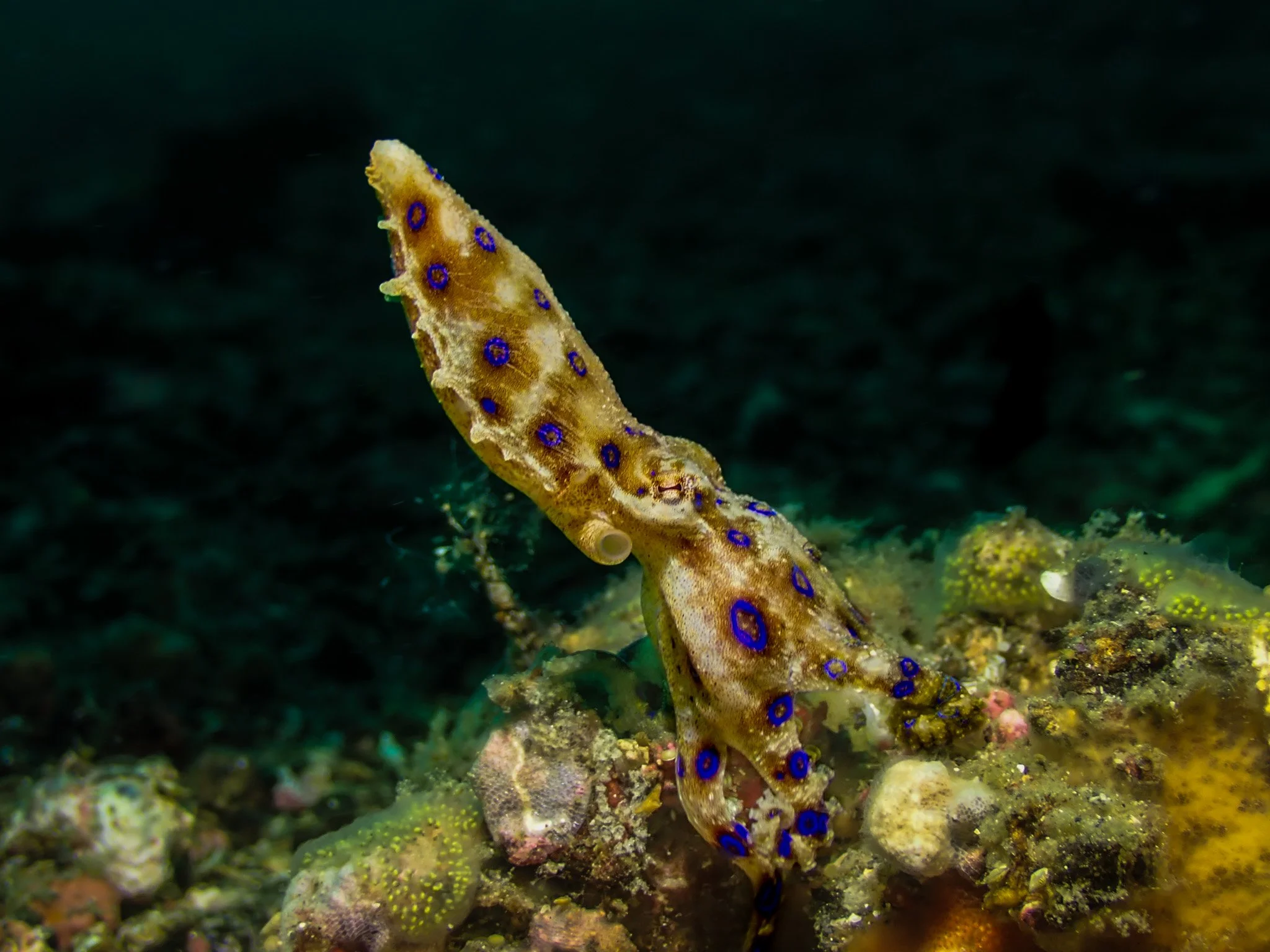
A blue-ringed octopus (Hapalochlaena sp.) spotted in Lembeh, Indonesia. Small but incredibly venomous, and absolutely fascinating to observe!
The Algae Octopus: A Walking Piece of Camouflage
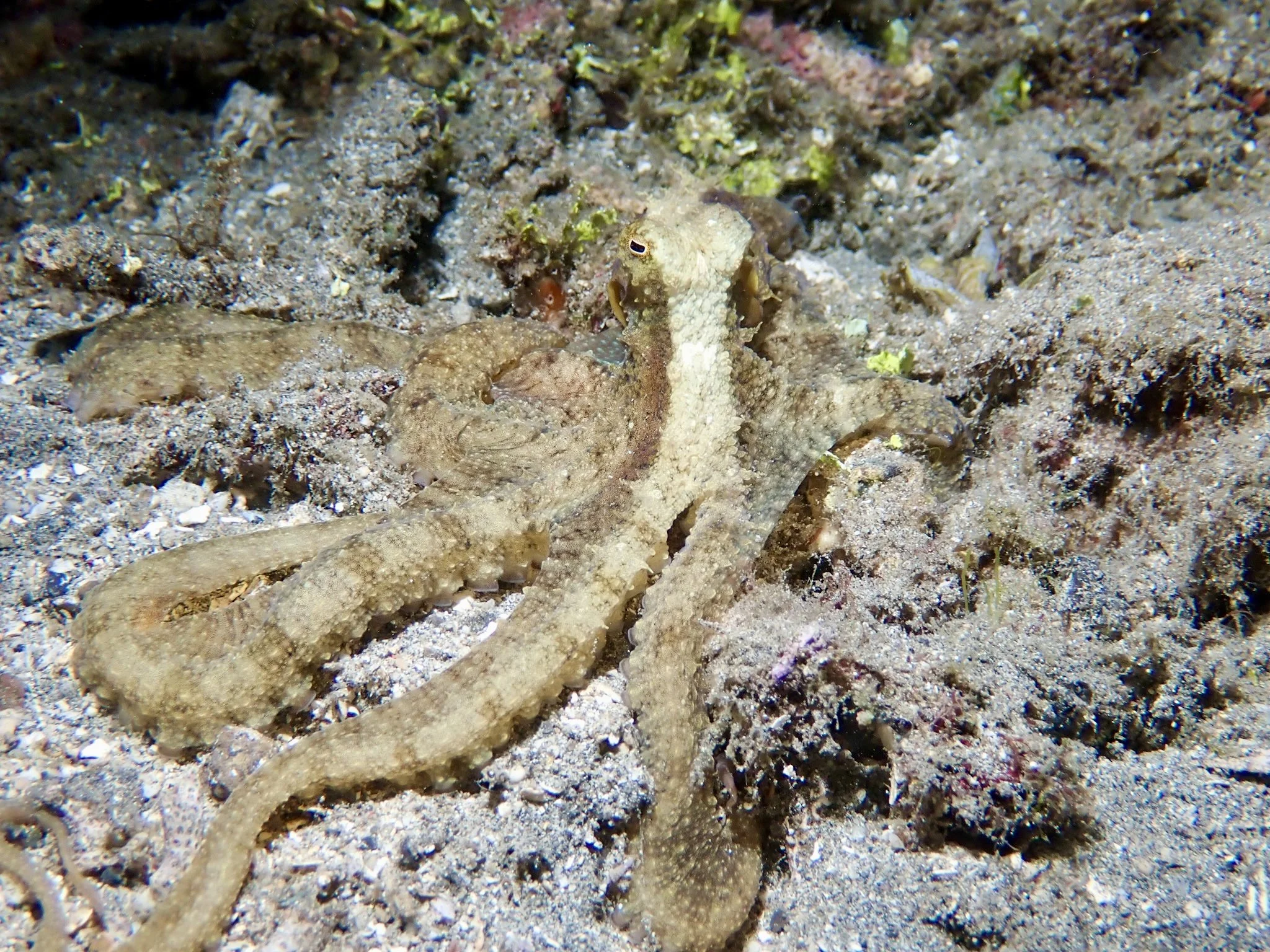
An algae octopus (Abdopus aculeatus) spotted at the Bianca dive site in Lembeh, Indonesia. A little master of camouflage, blending beautifully into its surroundings!
The algae octopus, Abdopus aculeatus, is another fascinating species found in shallow Indo-Pacific environments. Its name comes from its ability to resemble algae and other irregular features of the seafloor through changes in color, pattern, posture, and skin texture. These octopuses are particularly good at blending into environments where small pieces of rubble and vegetation create a complicated background. For anyone who loves searching for octopuses, they're a wonderful example of how easy it is to overlook an animal hiding in plain sight.
One of the most unusual behaviors documented in algae octopuses is bipedal locomotion. Researchers have observed individuals moving along the seafloor using two arms while arranging the others around their bodies to maintain an algae-like appearance. Rather than abandoning their camouflage to swim away, these octopuses can sometimes move while continuing to resemble part of the surrounding environment. A scientific study published in 2005 helped establish this remarkable behavior.
Their ability to combine camouflage and movement is particularly interesting because blending into the environment involves much more than simply matching colors. Body shape, texture, posture, and the way an animal moves can all influence whether a predator notices it. Watching an octopus essentially walk away while pretending to be algae is one of those things that makes marine biology endlessly entertaining.
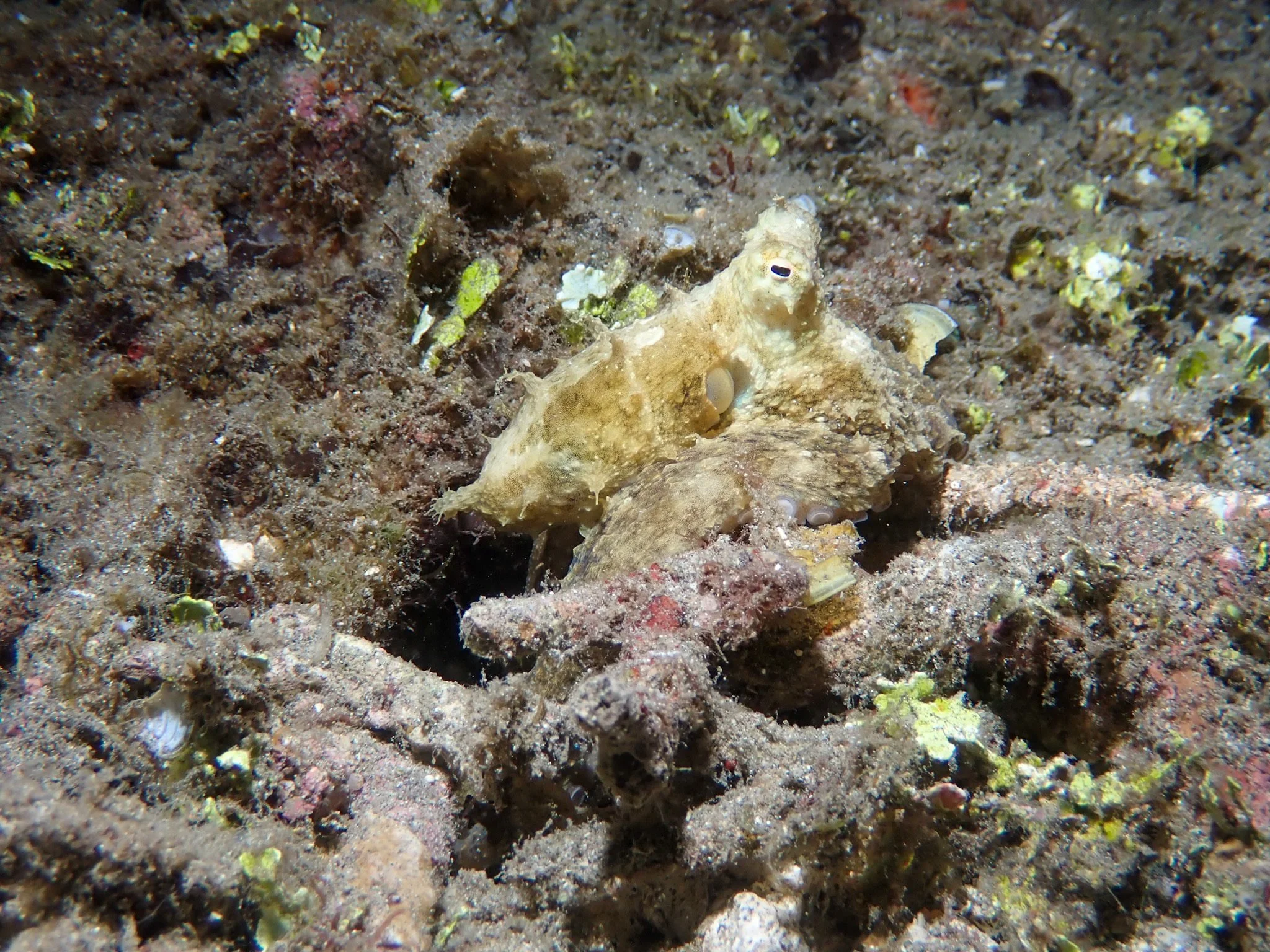
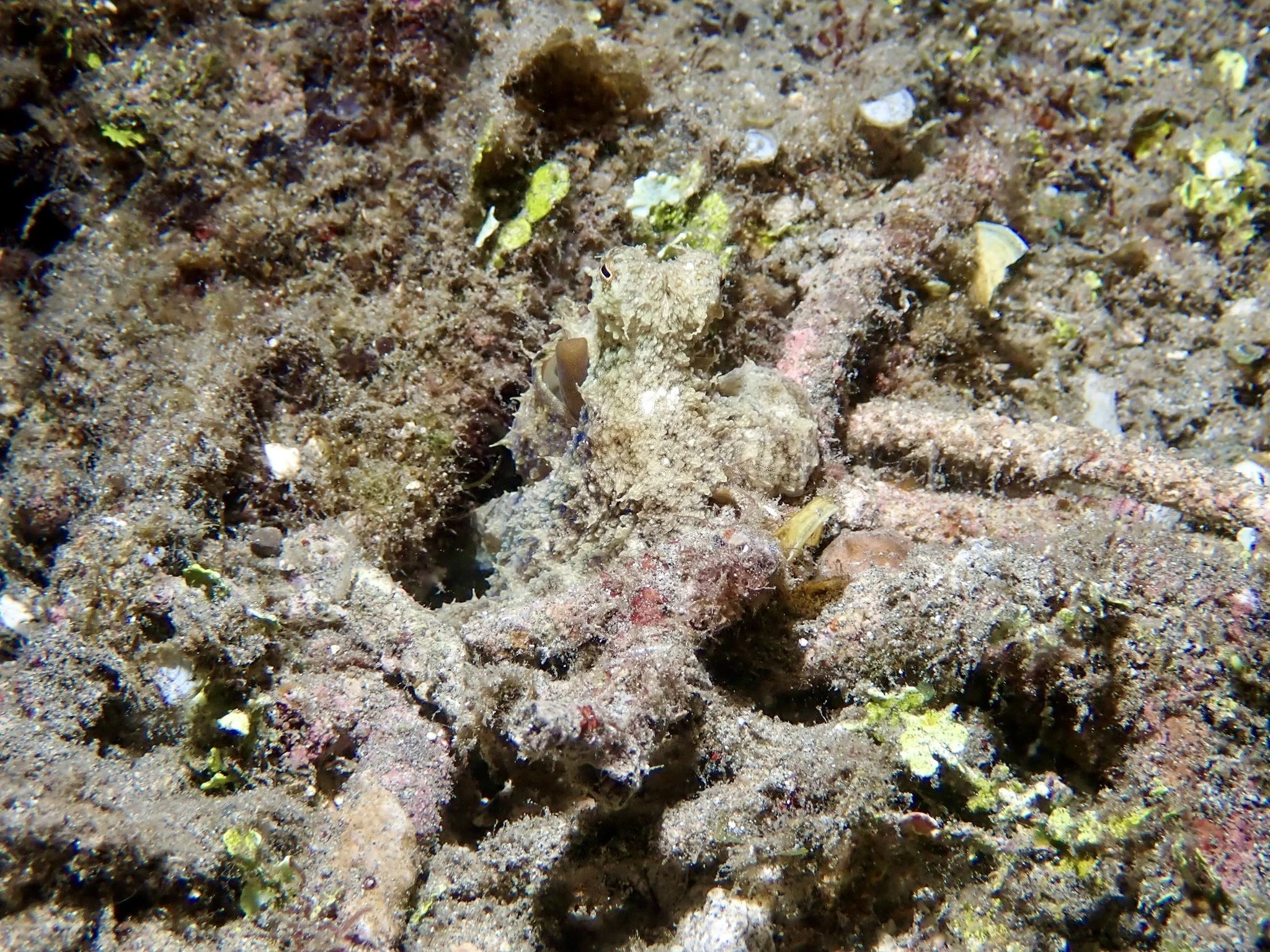
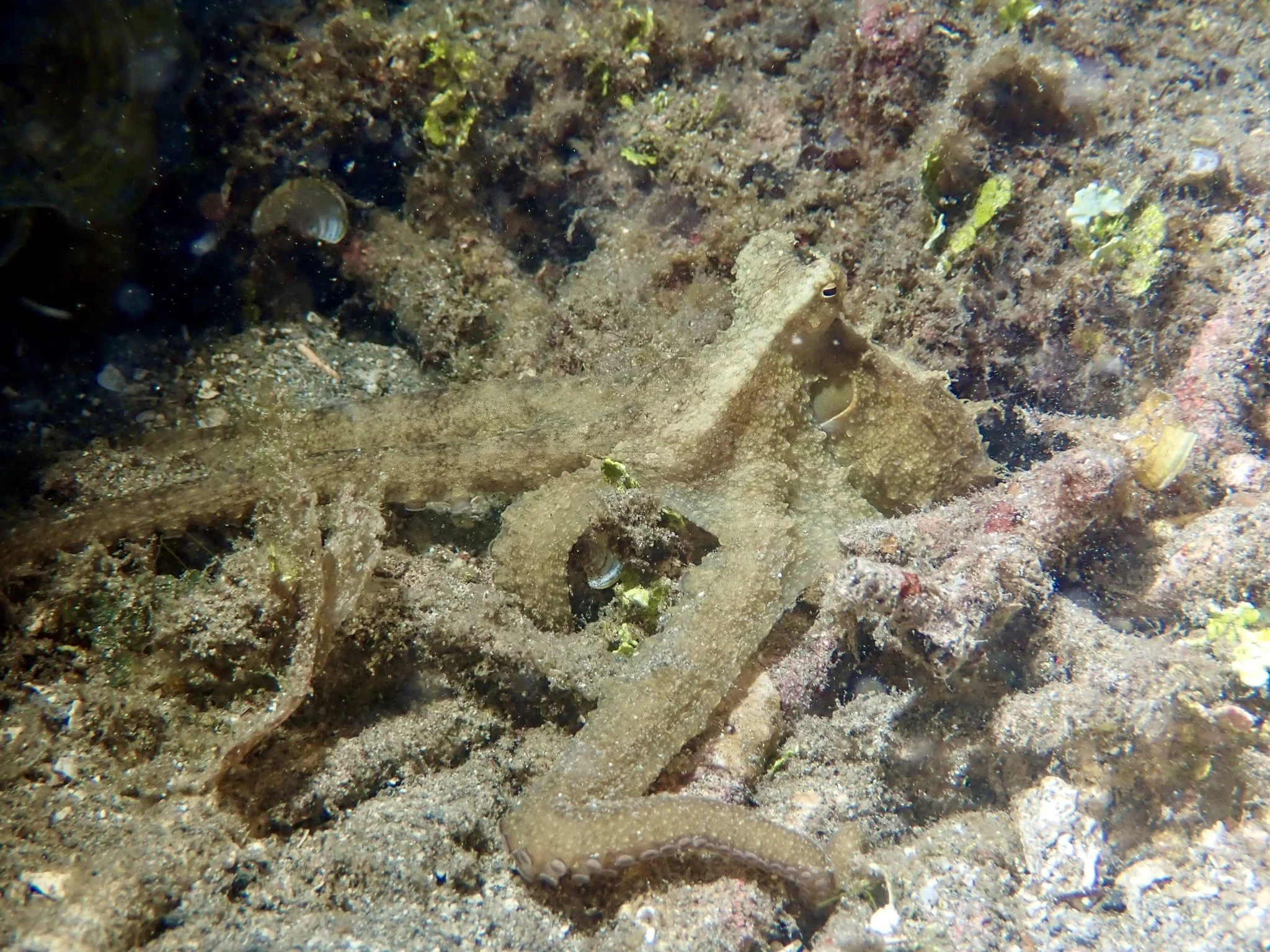
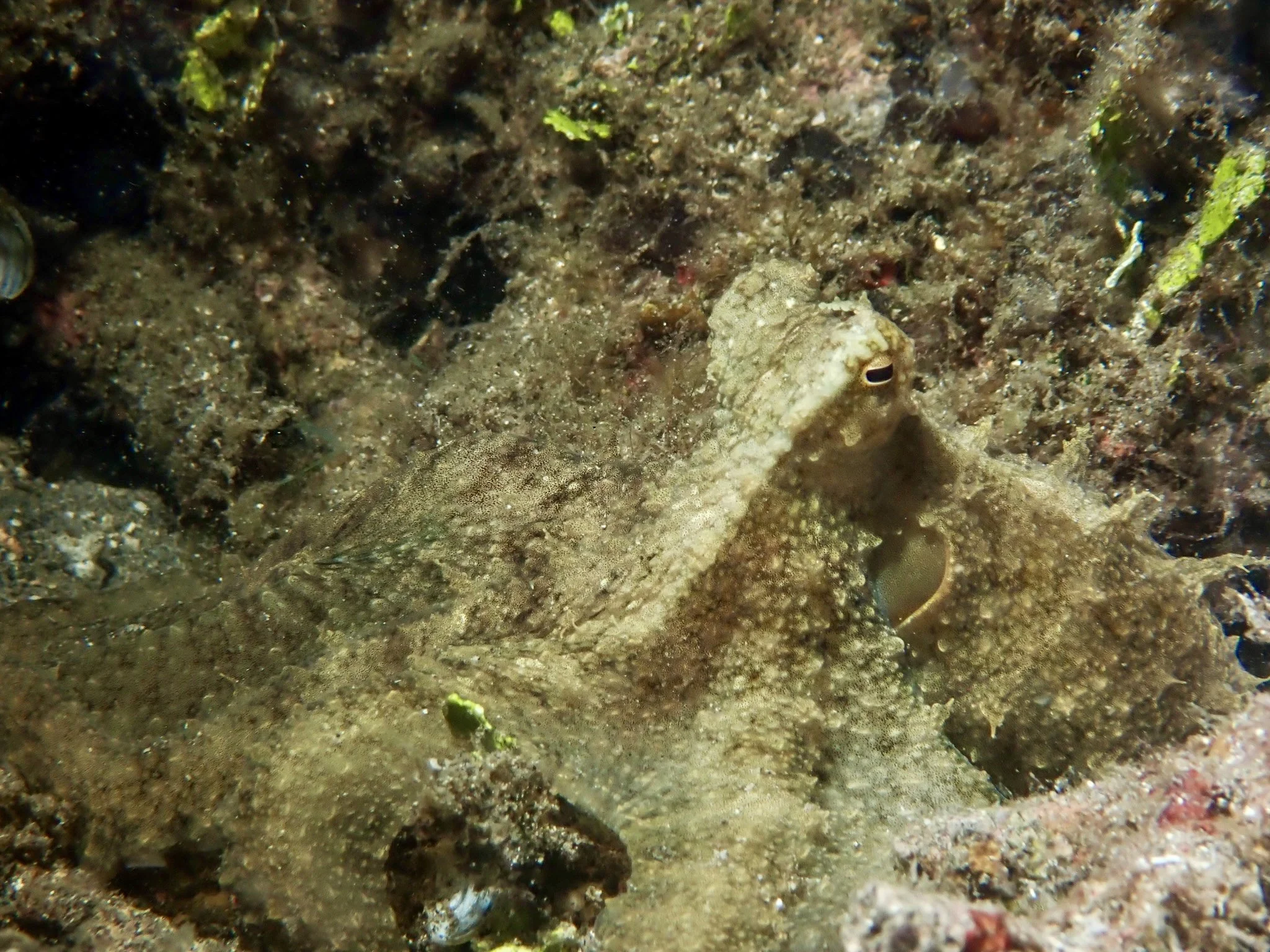
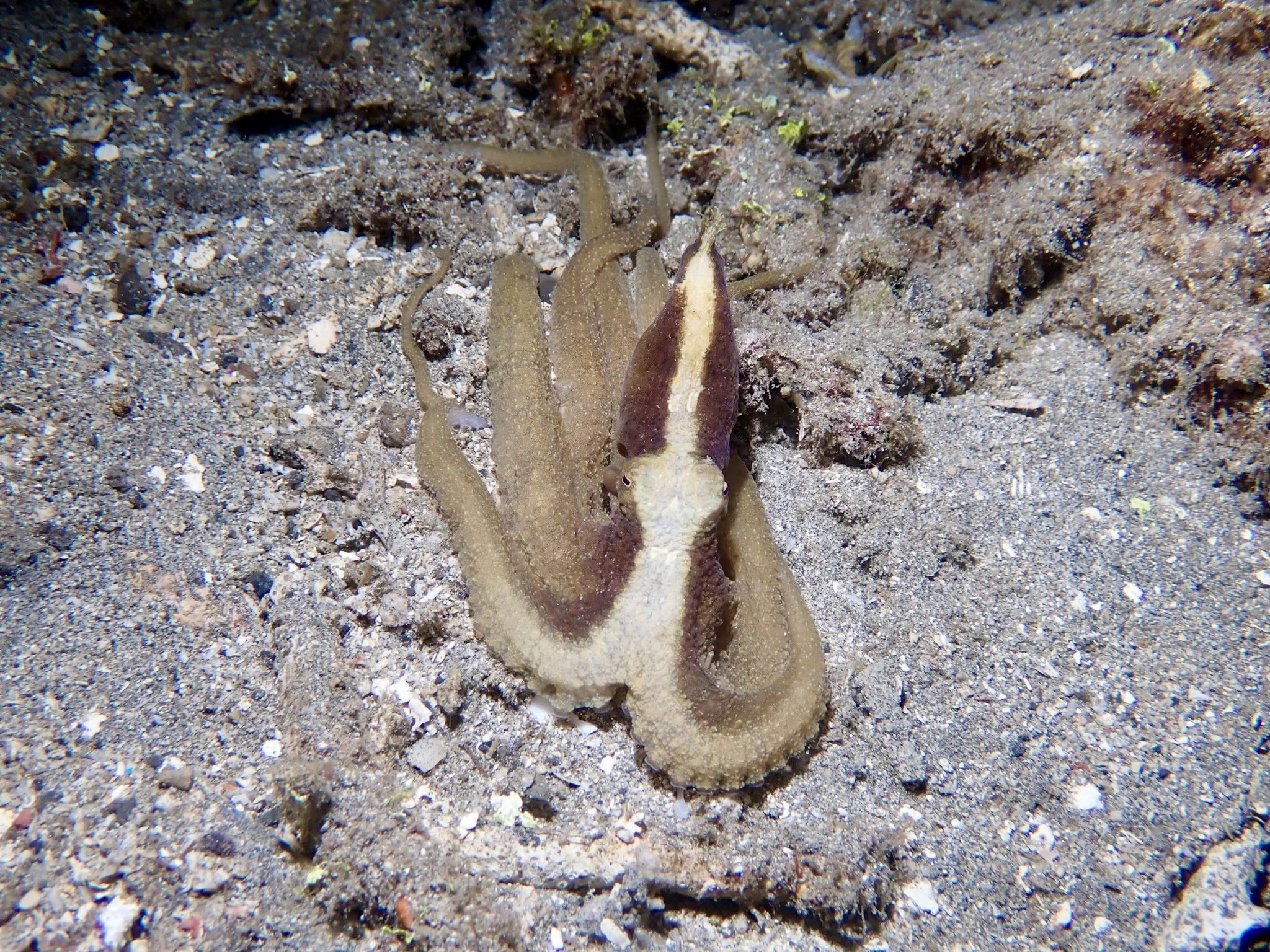
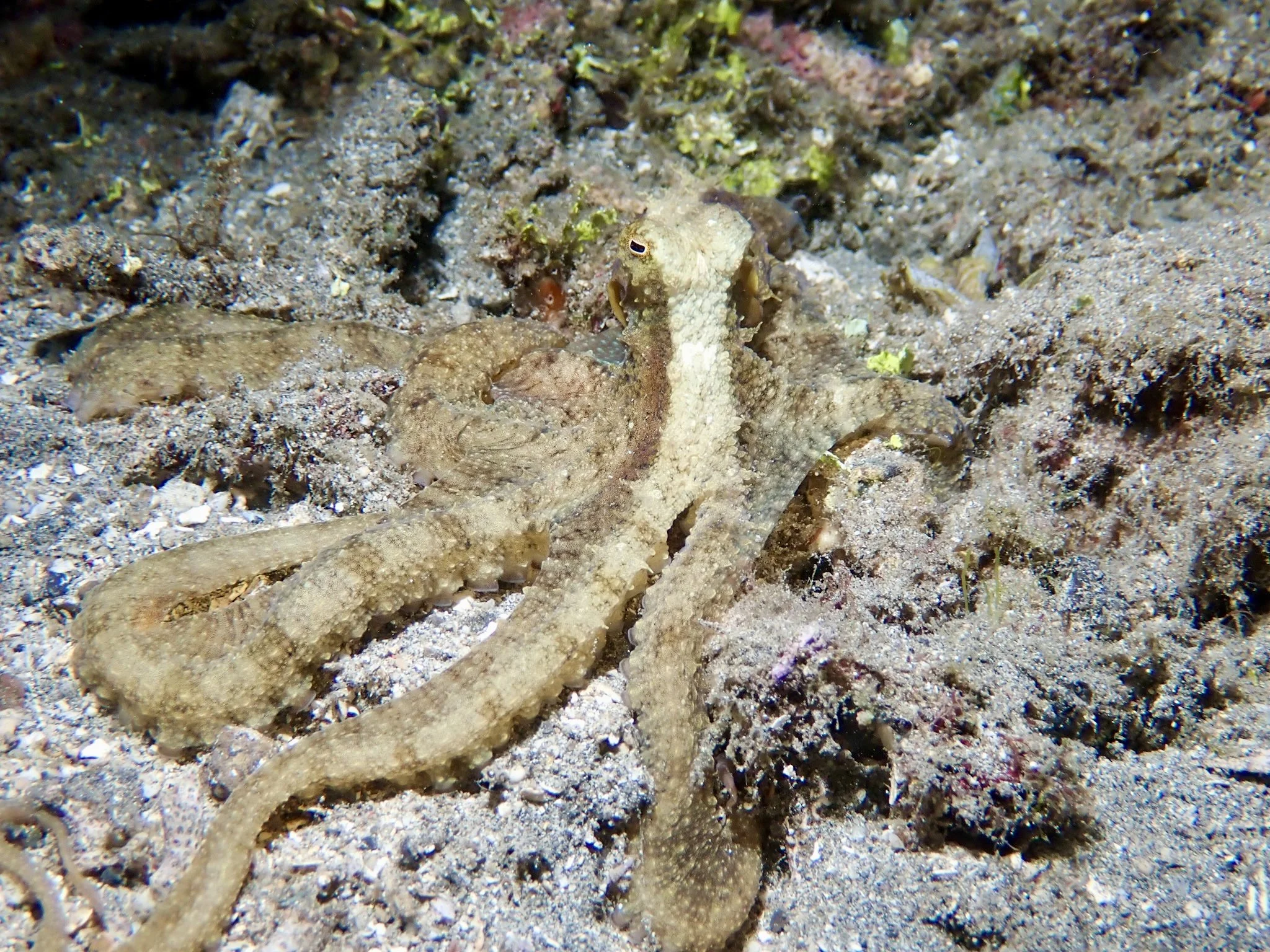
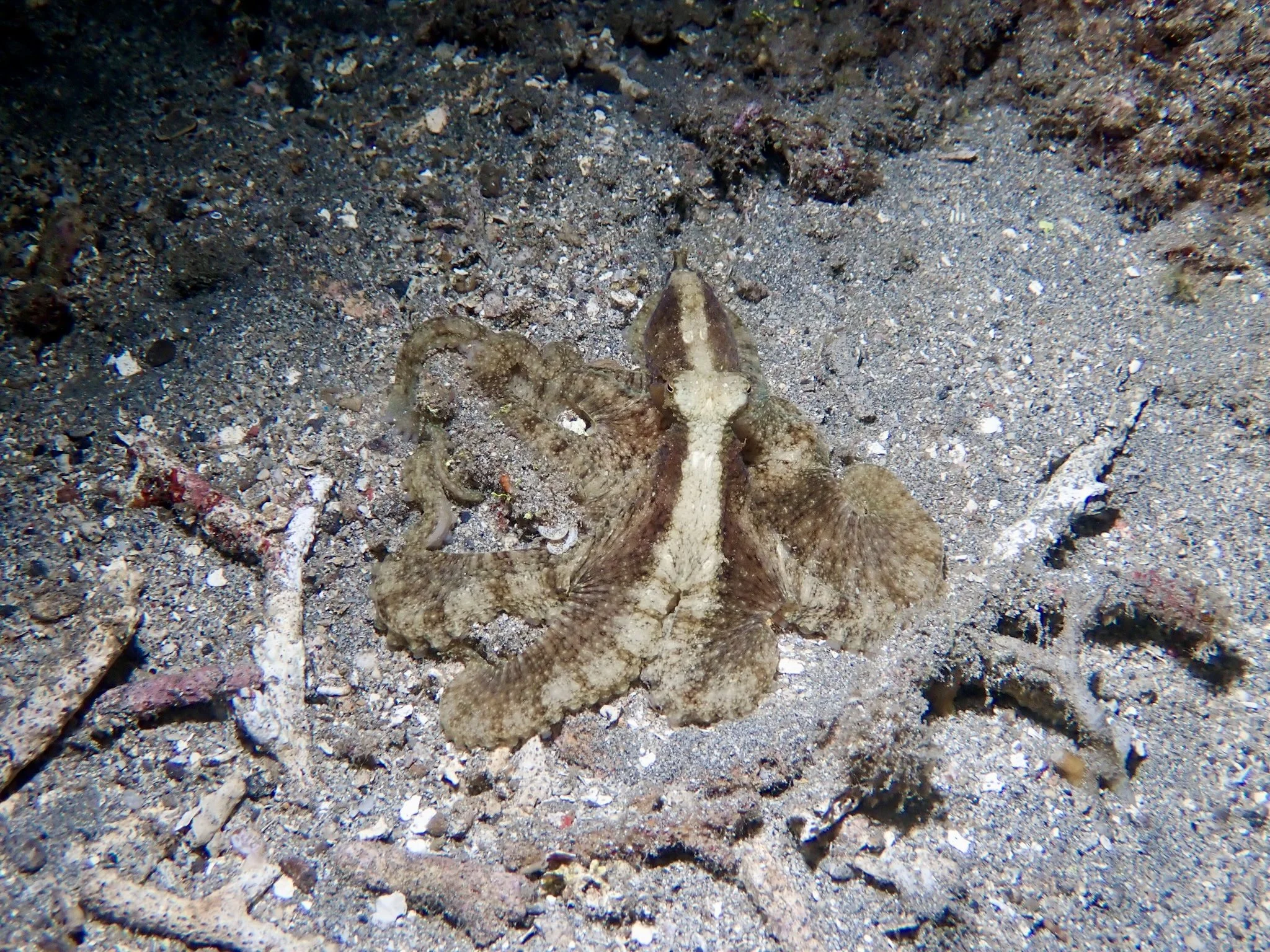
How cool are algae octopuses (Abdopus aculeatus)?! 🐙 This gallery features the same little octopus in Lembeh, changing its colors, patterns, and skin textures as it moved across the seafloor. It's incredible how different one octopus can look from one moment to the next! Take a look through the photos and see its amazing camouflage abilities in action.
The Long-Arm Octopus: A Reminder of How Much We Still Have to Learn
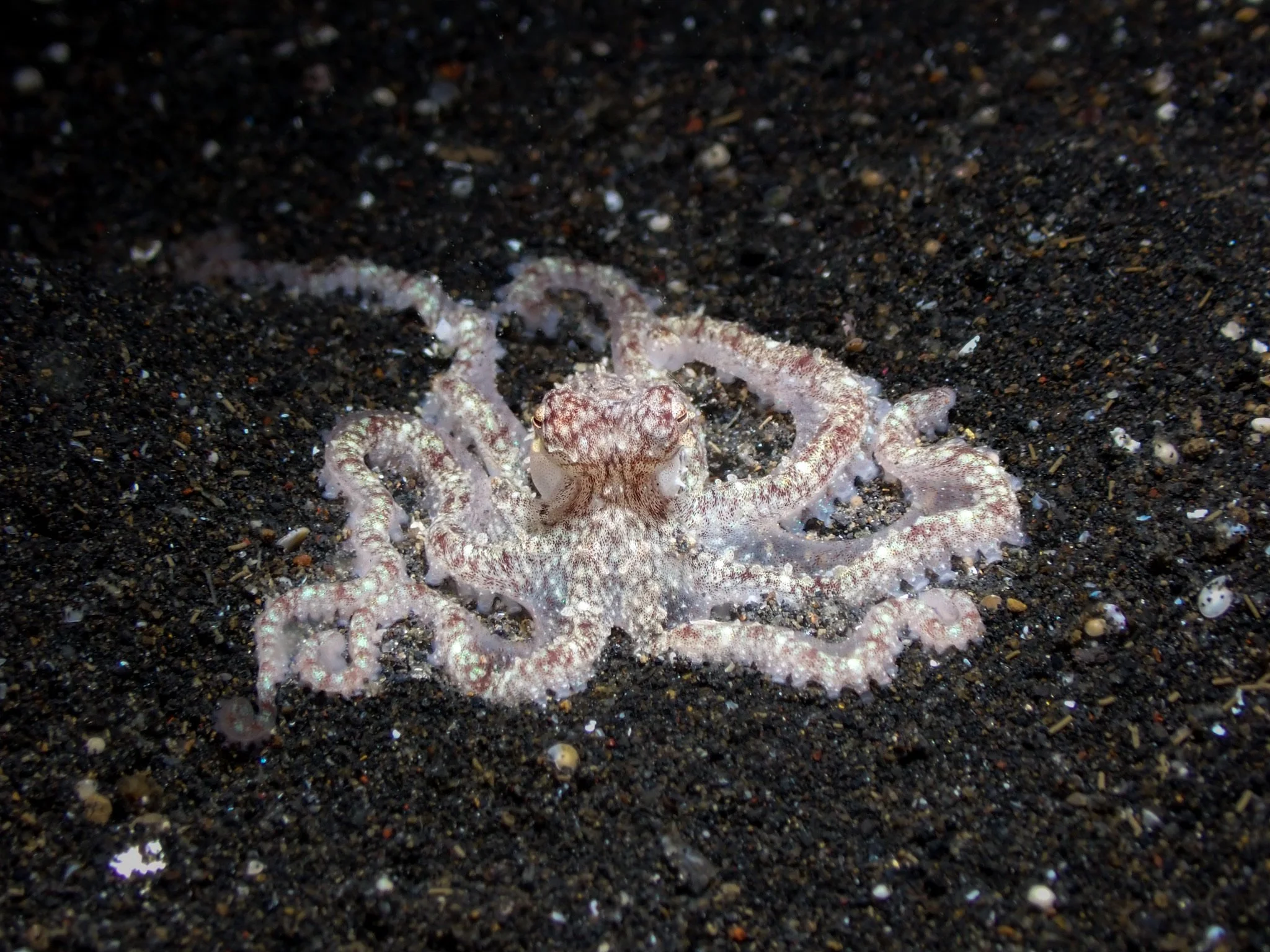
A long-arm octopus spotted during a night dive in Lembeh, Indonesia. With its incredibly long, slender arms, this fascinating little creature was one of the many surprises waiting for us after dark!
Long-arm octopuses are another wonderful example of the diversity hiding in Lembeh's sandy habitats. The common name is used for several slender-armed octopuses, and identifying an exact species can require careful examination of photographs and anatomical features. Rather than assign a scientific name to our Lembeh sighting without sufficient evidence, I'm keeping this one at the common-name level. Marine life identification isn't always straightforward, particularly when an animal is partially concealed or changing its appearance.
Their elongated, flexible arms are useful for exploring crevices, investigating sediment, and searching for small prey. Like other octopuses, they rely on a combination of vision, touch, and chemical sensing to explore their surroundings. Their body proportions can make them especially striking underwater, with arms that seem almost impossibly long compared with the mantle. Encounters like these remind me that finding an animal and confidently identifying its exact species aren't always the same thing.
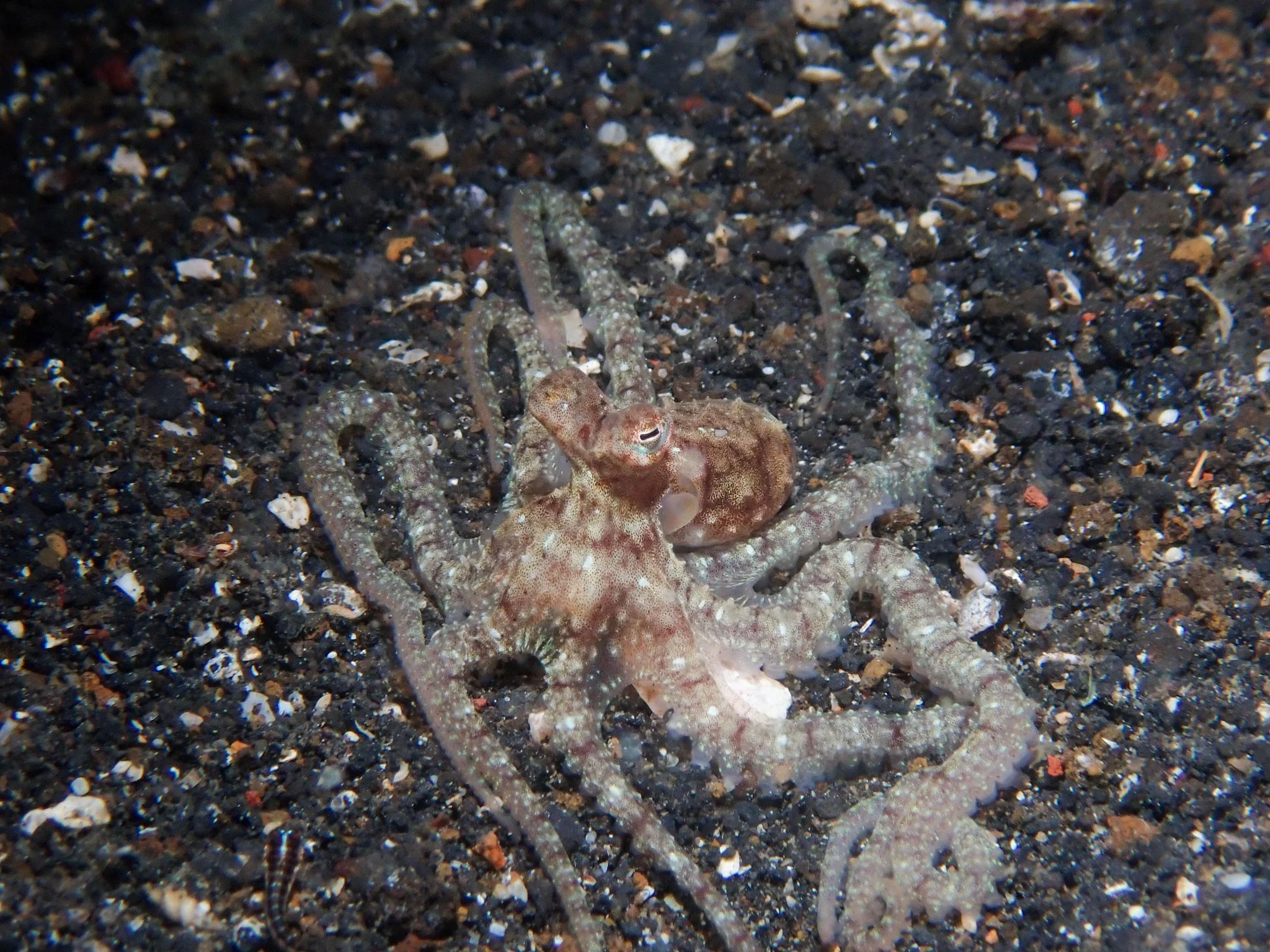
These little long-arm octopuses are surprisingly tiny! We spotted this one during a night dive in Lembeh, Indonesia, and within seconds, it had completely disappeared into the sand. Blink and you’ll miss it!
The Day Octopus: A Living, Breathing Kaleidoscope
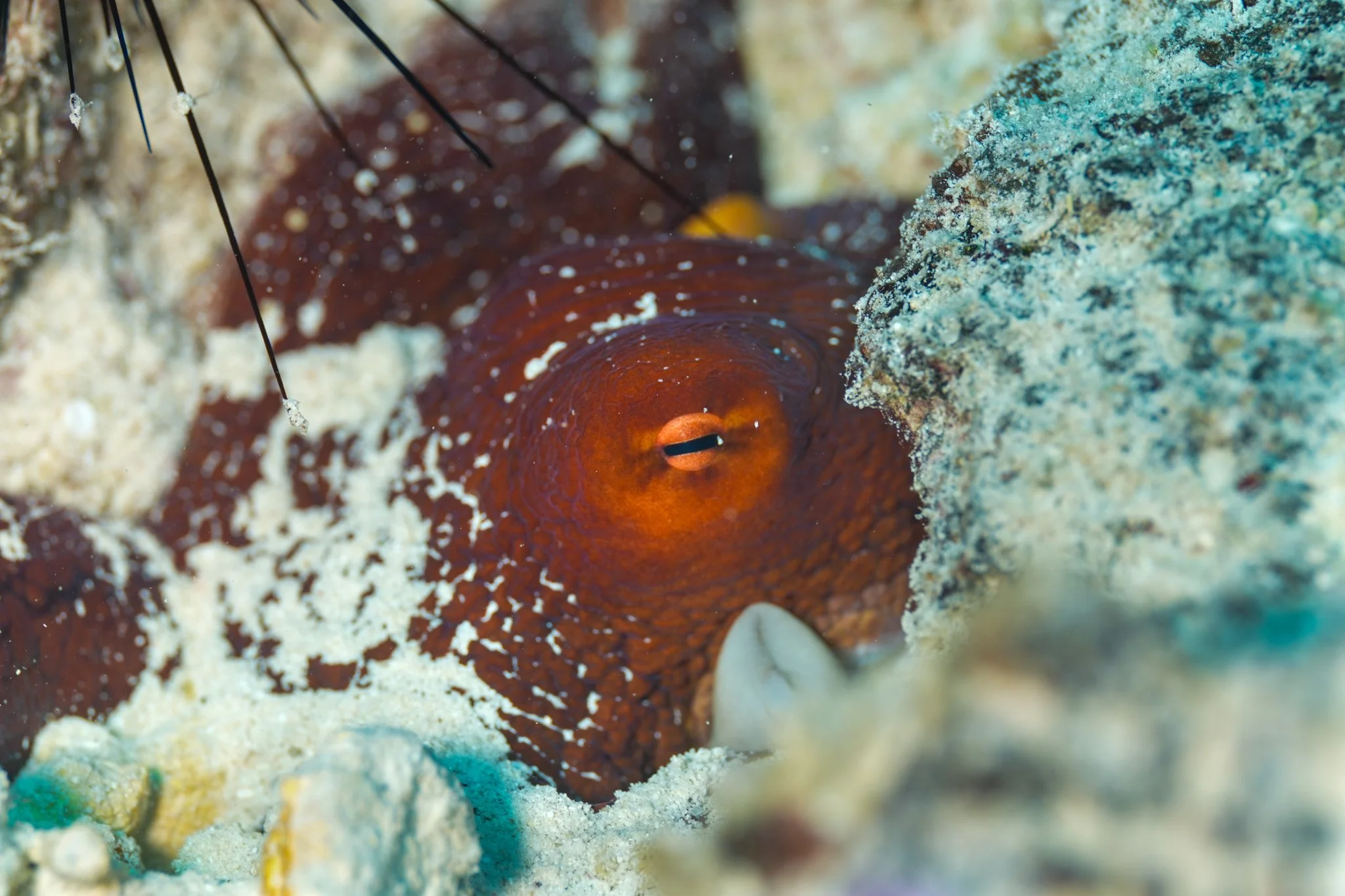
A day octopus (Octopus cyanea) spotted here in Hawaiʻi! I absolutely love the rich maroon colors these octopuses sometimes display, especially against the reef. Their constantly changing colors and textures never get old!
Here on Hawaiʻi Island, one of our familiar residents is the day octopus, Octopus cyanea, known in Hawaiian as heʻe. These octopuses are incredible camouflage artists, capable of changing their color, pattern, and skin texture in a matter of moments. Specialized pigment cells called chromatophores work alongside reflective cells and muscular structures called papillae to transform their appearance. One moment you're looking at a smooth patch of reef, and the next there's an octopus covered in bumps and patterns that make it nearly indistinguishable from the surrounding coral.
During our Seaira Dives trip to Fiji, we encountered several large day octopuses, and watching them transition between different colors, patterns, and skin textures was incredible. One moment an octopus would appear relatively smooth, and the next its skin would develop raised bumps and contrasting patterns that helped it blend into the surrounding reef. Their ability to transform their appearance so quickly is something photographs can never fully capture. I've spent plenty of time watching octopuses underwater, but seeing those changes happen right in front of me never gets old. They're absolute masters of disguise, and I could happily spend an entire dive watching them.
Day octopuses are active hunters that search reef crevices and rubble for crabs, shrimp, mollusks, and other prey. Their flexible arms allow them to investigate multiple hiding places, while their suckers gather information about whatever they're touching. Here's one of my favorite facts: octopus suckers contain specialized sensory receptors that allow them to detect certain chemicals through contact. Researchers sometimes describe this as tasting by touch, which is a pretty incredible way to explore the world.
Imagine being able to investigate several hiding places while essentially tasting your surroundings with your arms. Their distributed nervous system allows the arms to process some sensory information locally, rather than relying entirely on the central brain for every movement. That arrangement helps octopuses coordinate incredibly complex movements while exploring their environments. Grocery shopping would certainly be more efficient with eight arms, although I suspect I'd spend even more money.
Octopuses also have a remarkable ability to squeeze into tight spaces because they lack a rigid internal or external skeleton. Their hard beak is one of the main anatomical structures limiting the size of openings they can pass through. This flexibility allows them to retreat into tiny dens, reach prey hidden deep in crevices, and escape predators. For divers, that means an octopus can disappear into a hole that seems impossibly small for the animal you were just watching.
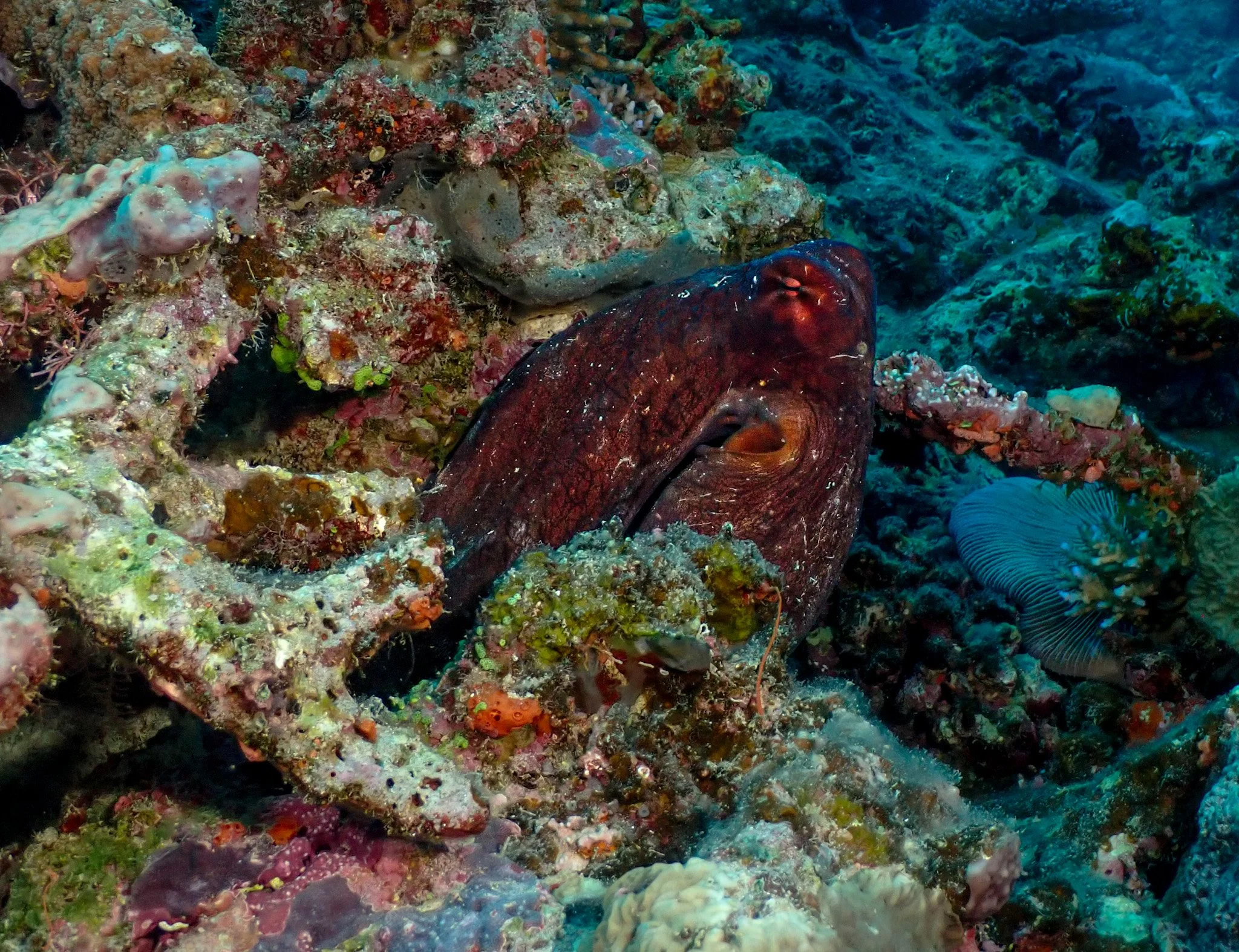
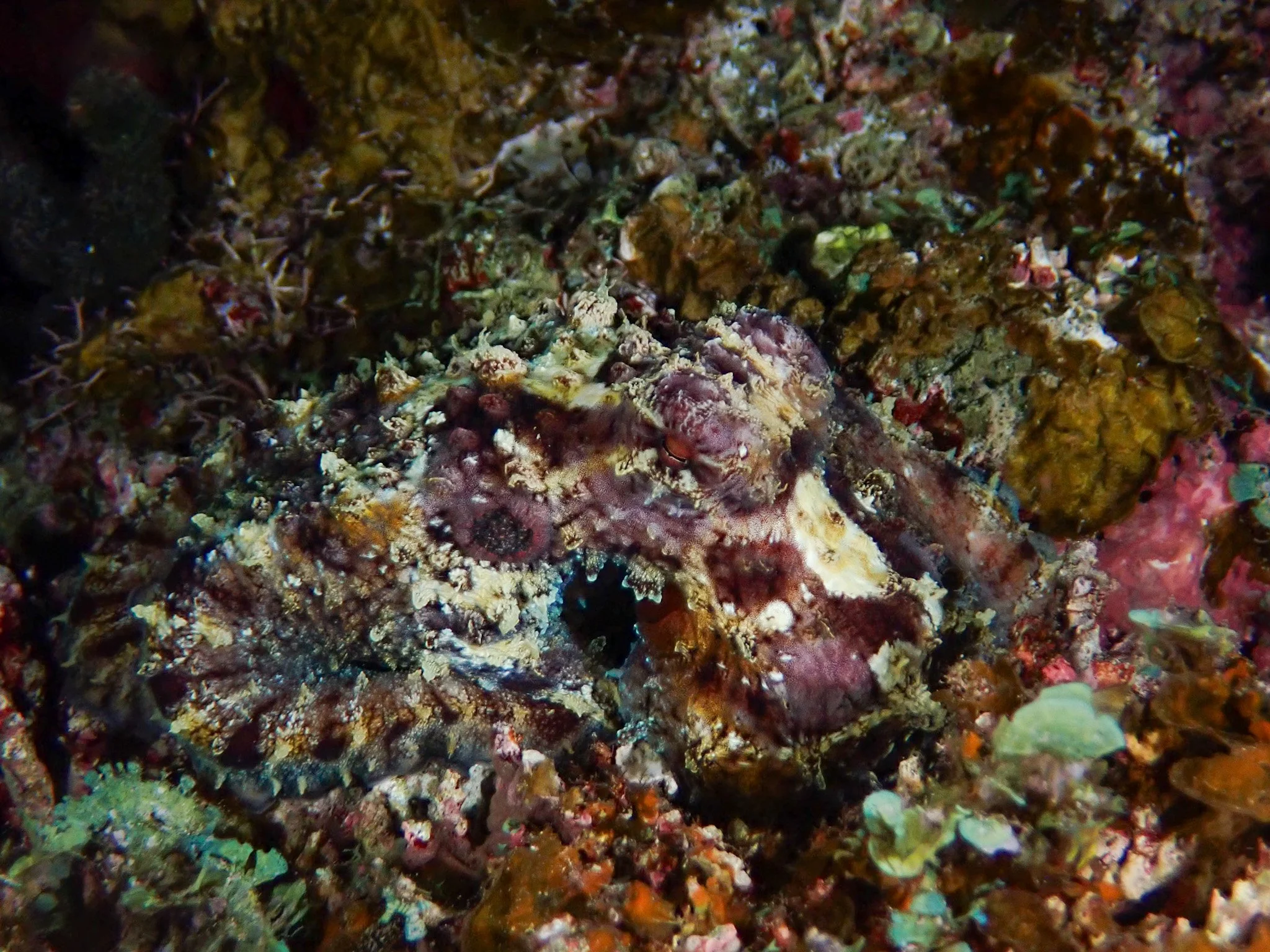
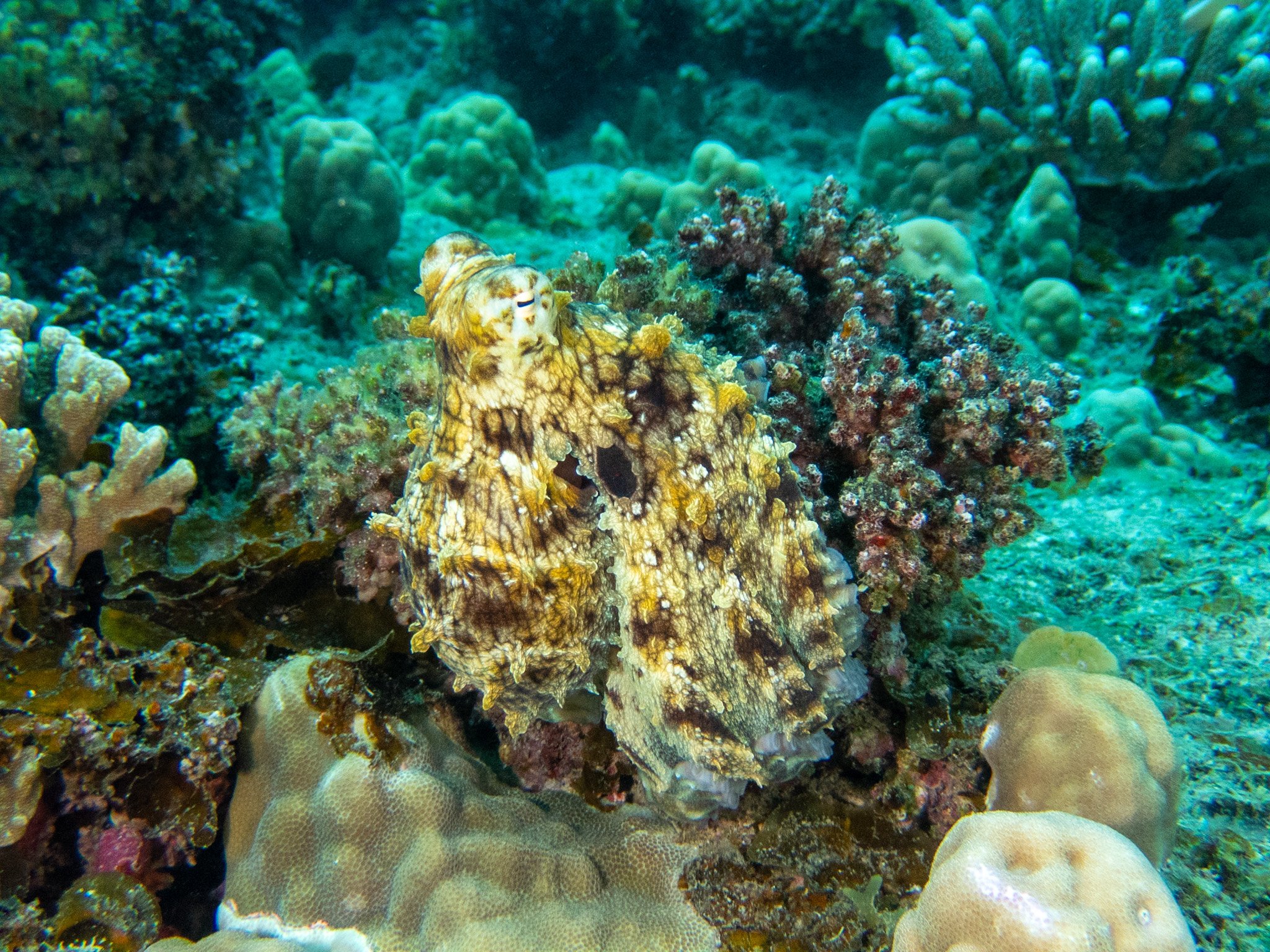
A day octopus (Octopus cyanea) spotted in Fiji, showing off its incredible camouflage abilities! Watch as it changes colors, patterns, and skin textures right before our eyes, blending seamlessly into the surrounding reef. Nature's ultimate master of disguise!
The Incredible Anatomy of an Octopus
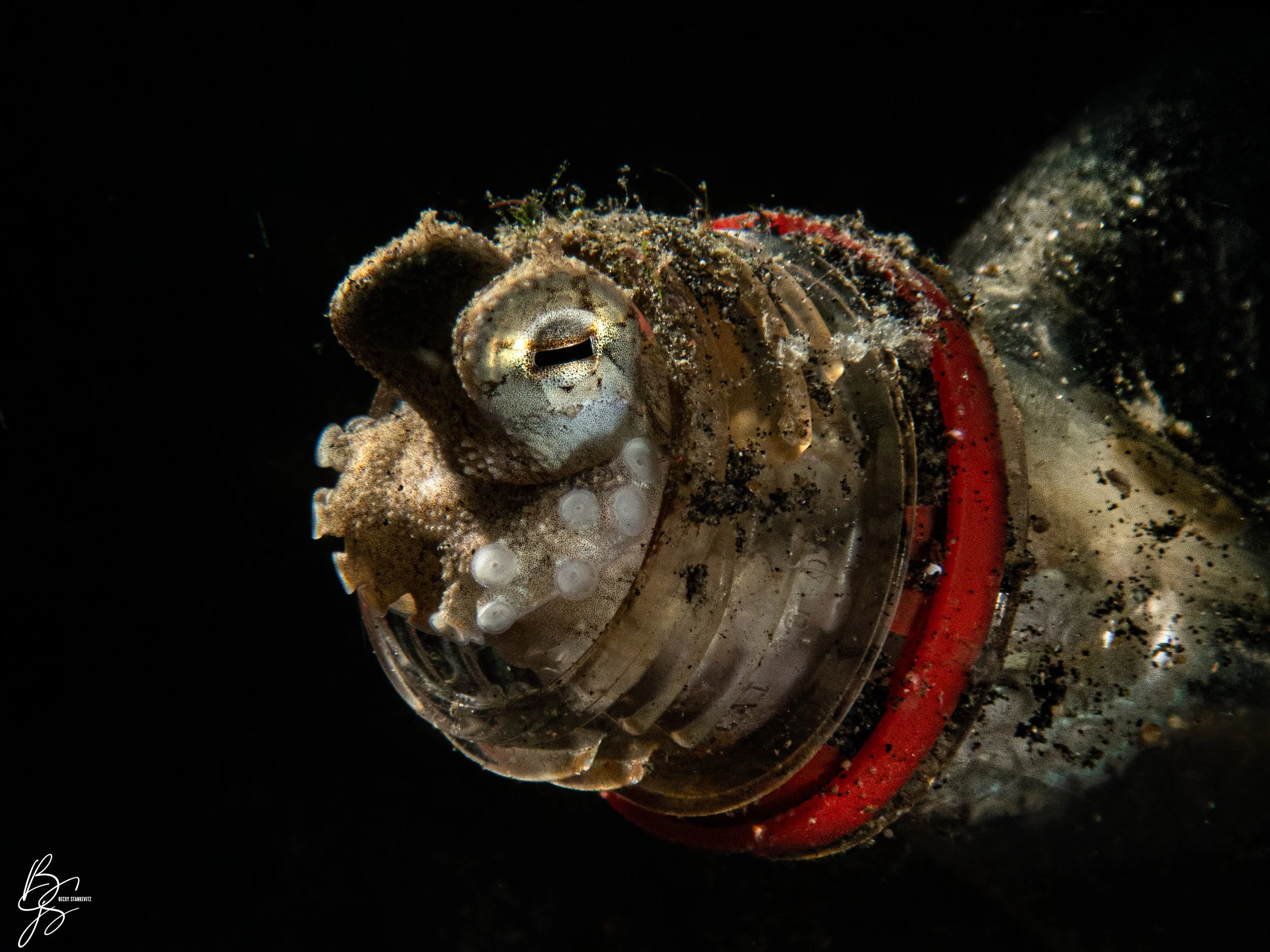
A coconut octopus living in a Diet Coke bottle? Becky is also a Diet Coke fan! As adorable as this little octopus is, it's an important reminder that our trash doesn't belong in their ocean. Photo courtesy of Becky Stankevitz
Octopus anatomy is every bit as strange as their behavior, beginning with the fact that they have three hearts. Two pump blood through the gills, while the third circulates oxygenated blood throughout the body. Their blood contains hemocyanin, a copper-containing oxygen transport protein that gives oxygenated blood its characteristic blue color. Between the extra hearts, blue blood, and eight arms covered in suckers, these animals sound like something from a science-fiction movie.
You've probably heard people say that octopuses have nine brains, but that description is misleading. Octopuses have one central brain and extensive neural networks throughout their arms, allowing substantial sensory processing and coordination outside the central brain. A large proportion of their neurons are distributed through their arms, helping them investigate objects and control complex movements. The arms aren't eight completely independent brains, but their nervous system is organized very differently from ours.
Their intelligence is another reason scientists find them so fascinating. Octopuses can learn from experience, solve certain problems, manipulate objects, and remember information, although abilities vary among species and individuals. Their sophisticated camouflage systems and well-developed eyes also raise interesting questions about how they perceive their surroundings. Many octopuses appear to have limited conventional color vision, yet they're capable of matching the appearance of remarkably complicated environments. Scientists continue to investigate how their visual systems, skin, and nervous systems work together to produce those transformations.
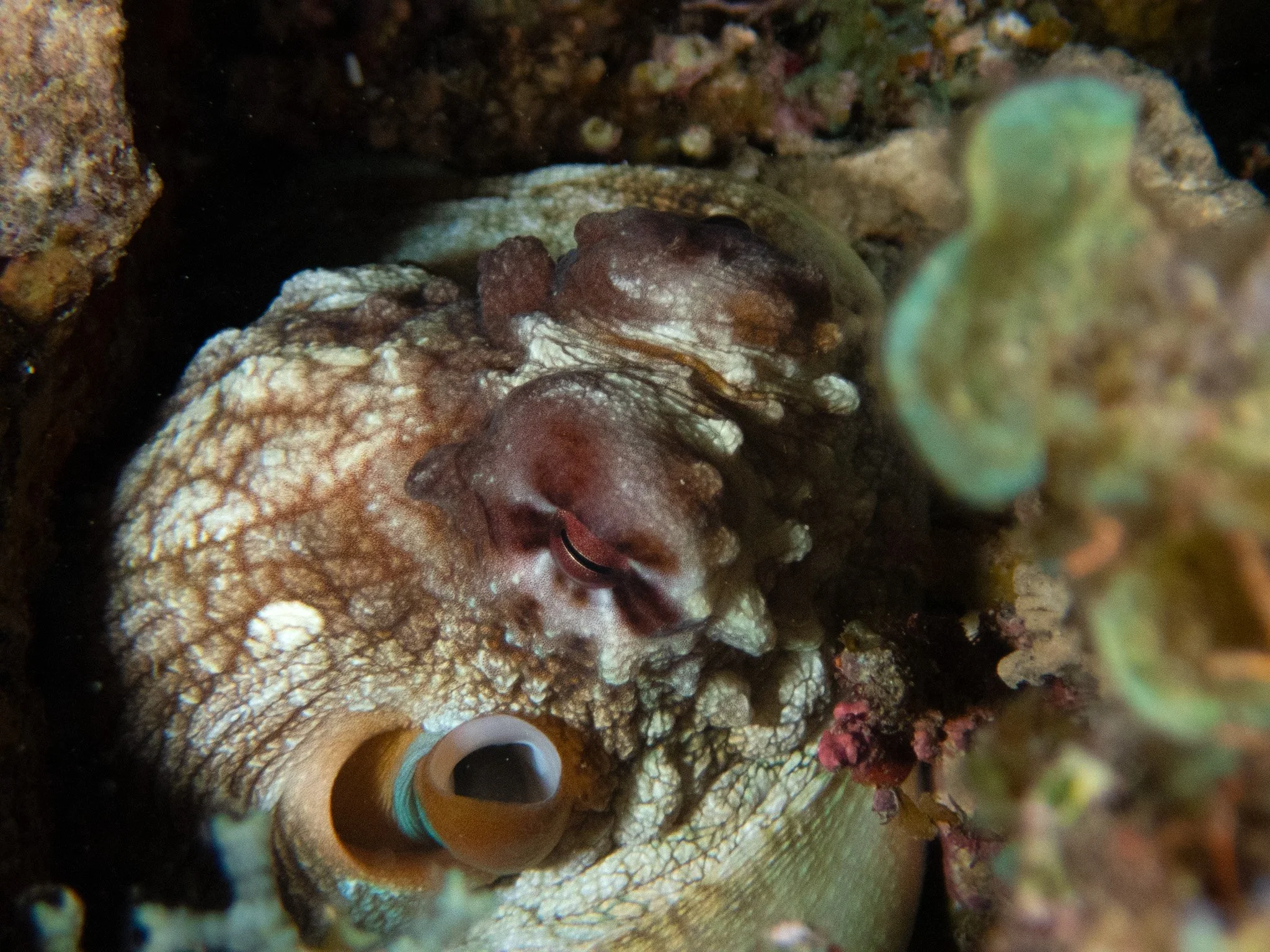
A day octopus (Octopus cyanea) spotted during a night dive in Fiji! Even after dark, these incredible camouflage artists can change their colors, patterns, and textures to blend into the reef. Always a treat to find one!
Mating, Motherhood, and the Short Lives of an Octopus
For all their intelligence and extraordinary adaptations, many octopus species have surprisingly short lives. Smaller species may live only a year or two, while some larger species, including the giant Pacific octopus, can live several years. Most octopuses reproduce only once, and reproduction is followed by a significant decline in the adults' health. Their life histories vary between species, but the amount of energy many females devote to protecting their eggs is remarkable.
After mating, females of many species lay eggs in protected locations and spend extended periods guarding them. They clean the eggs, move water over them to maintain oxygen availability, and defend them from potential predators. Some females stop feeding during this period and die around the time their eggs hatch. The length of brooding depends on the species and environmental conditions, particularly temperature.
Wunderpus octopuses have been observed carrying strings of eggs within their arms, offering an interesting contrast to species that attach eggs to the surfaces of protected dens. Scientists have documented aspects of this behavior in captivity, although the reproductive biology of many octopus species remains incompletely understood. Depending on the species, hatchlings may enter a drifting planktonic stage or emerge as relatively well-developed young that remain near the seafloor. Their reproductive diversity is another reminder that there's no single octopus life story.
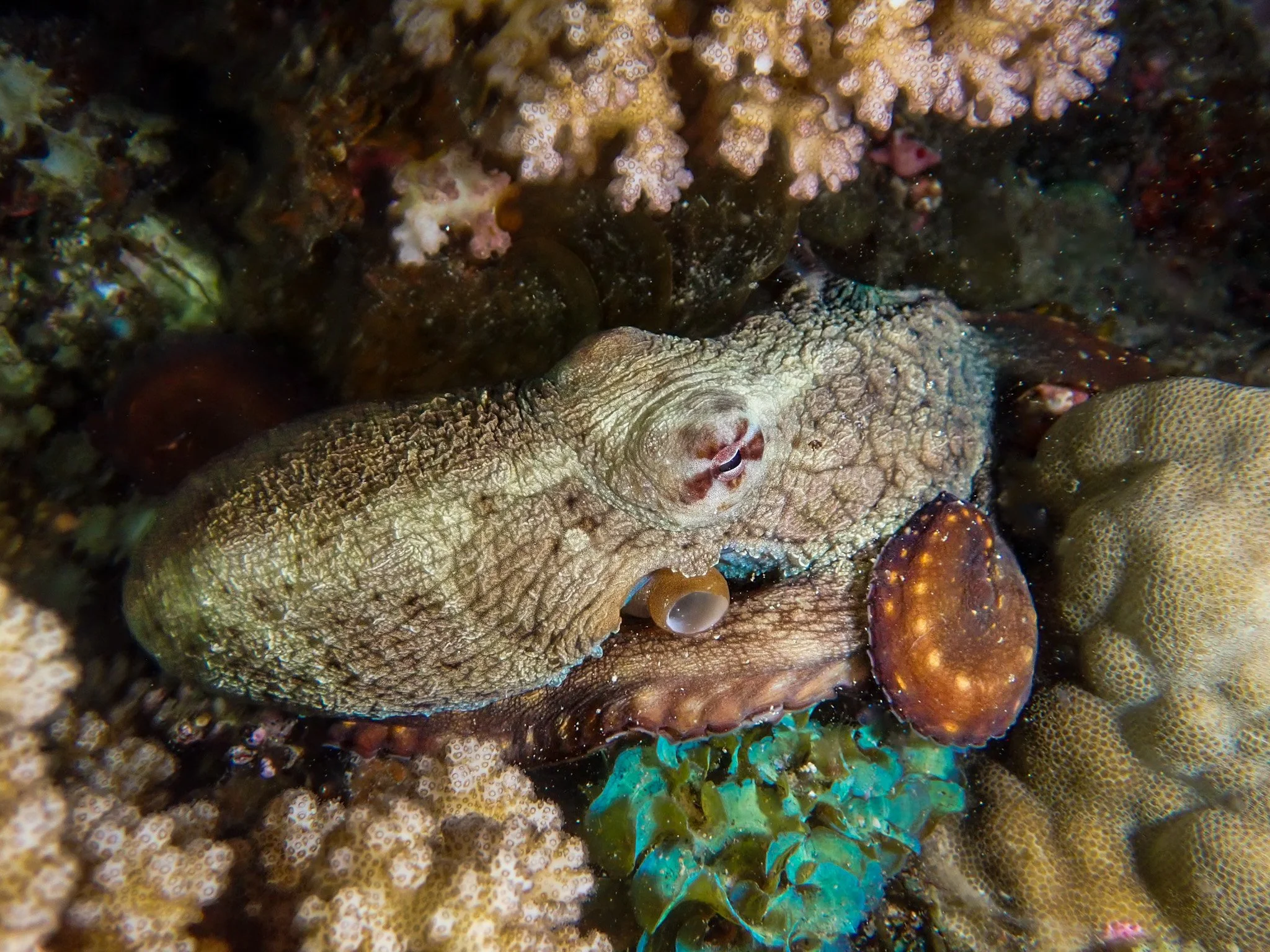
A large day octopus (Octopus cyanea) on the move during a night dive in Fiji! Watching those eight arms navigate the reef while its colors and textures constantly shift is absolutely fascinating.
How to Have a Great Octopus Encounter
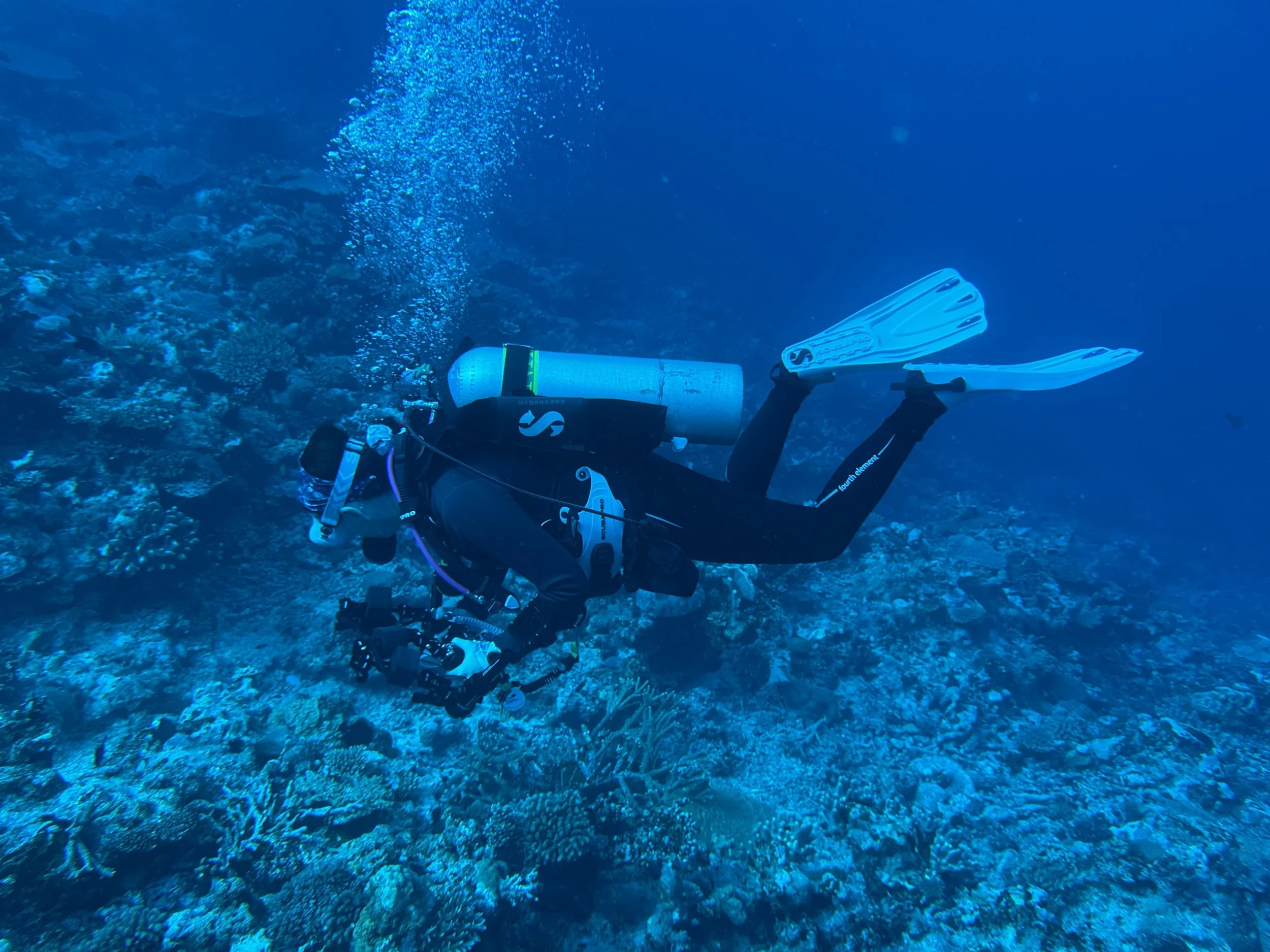
What a way to start a night dive in Fiji! Spotted a beautiful octopus just as the sun was setting and the reef was transitioning from day to night.
As much as I love finding octopuses, I think there's something every diver and underwater photographer needs to understand: just because we find an animal doesn't mean it wants anything to do with us. Octopuses are highly responsive to their surroundings, and their behavior can change when they notice a potential threat. Some will continue hunting or exploring while a diver watches from a respectful distance, while others immediately retreat into their dens. Learning to recognize those differences is an important part of becoming a better underwater observer.
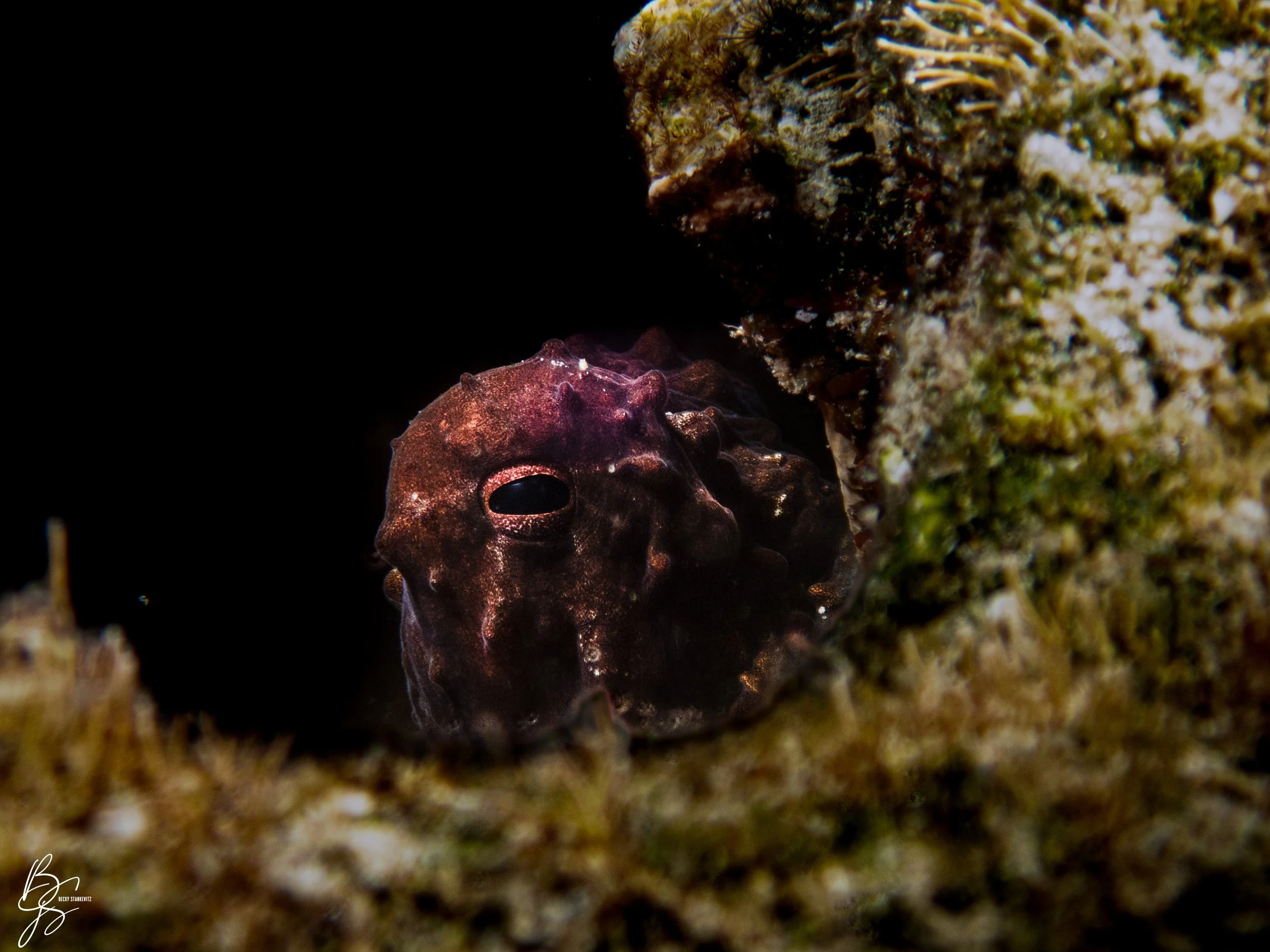
Peekaboo! This little octopus is tucked into its rocky hiding spot, keeping one eye on the world outside.
Photo courtesy of Becky Stankevitz
My favorite approach is to slow down, maintain good buoyancy, and pay attention to the little details around the reef or seafloor. Look for eyes peeking out from crevices, piles of discarded shells near possible dens, or subtle movements that don't quite match the surrounding environment. When I find an octopus, I give it space and observe its behavior before deciding whether to stay and watch. Sometimes remaining still is all it takes for the animal to resume whatever it was doing before I arrived. Those are often the encounters I enjoy the most.
Octopuses can change color or texture for many reasons, including camouflage, communication, hunting, and defensive responses, so a sudden color change alone doesn't necessarily mean an animal is frightened. However, repeated attempts to retreat, disappearing deeper into a den, inking, or rapidly escaping are good reasons to stop approaching. If an octopus is clearly skittish or trying to get away, respect that behavior and leave it alone. There's no reason to follow an animal across the reef simply because you want a better photograph.
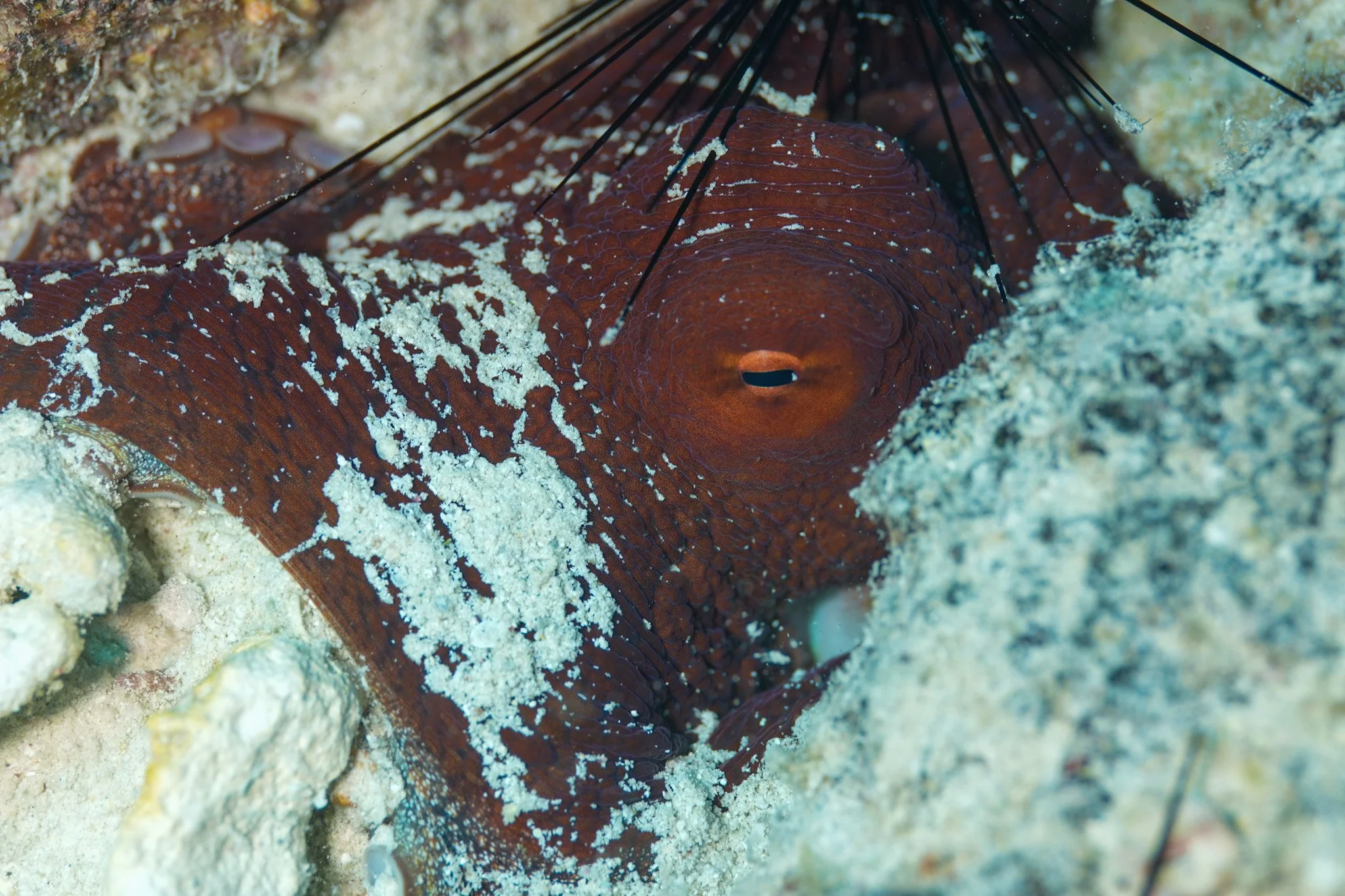
A Hawaiian day octopus (Octopus cyanea), known locally as heʻe, looking completely unbothered by its rather precarious position beneath a sea urchin. Just another day on the reef in Hawaiʻi!
I also have a firm rule about never pulling an octopus out of its den, poking it to encourage a reaction, or blocking its escape route. Moving shells or rocks around an occupied den, surrounding the animal with multiple divers, or repeatedly shining bright lights into its hiding place can interfere with its natural behavior. Those shelters are important for avoiding predators, resting, and sometimes protecting eggs. An octopus doesn't owe us a performance just because we managed to find it.
This is especially important with species like the coconut octopus. Finding one carrying or occupying shells is exciting, but moving those shells to get a better view interferes with the very behavior we're there to appreciate. The same goes for a mimic octopus sheltering in the sand or a mototi displaying its distinctive markings. We shouldn't poke the substrate, disturb a shelter, or intentionally frighten an animal just to produce a particular photograph or behavior.
Sometimes the best octopus encounter lasts only a few seconds. You spot the animal, recognize that it's uncomfortable with your presence, and move along without trying to force anything. Other times, an octopus continues hunting or exploring while you quietly observe from a respectful distance, and you get to watch some incredible behavior. Neither outcome is a failure, because the goal should never be to make an animal interact with us.
I think divers sometimes forget that we're visitors in these animals' homes. We're there for an hour or so, while the octopus is trying to find food, avoid predators, protect its shelter, and generally survive another day. Giving an animal space doesn't make an encounter less meaningful, and leaving a skittish octopus alone is often the most responsible decision you can make. Besides, there's a pretty good chance another suspicious-looking rock is waiting just around the corner.
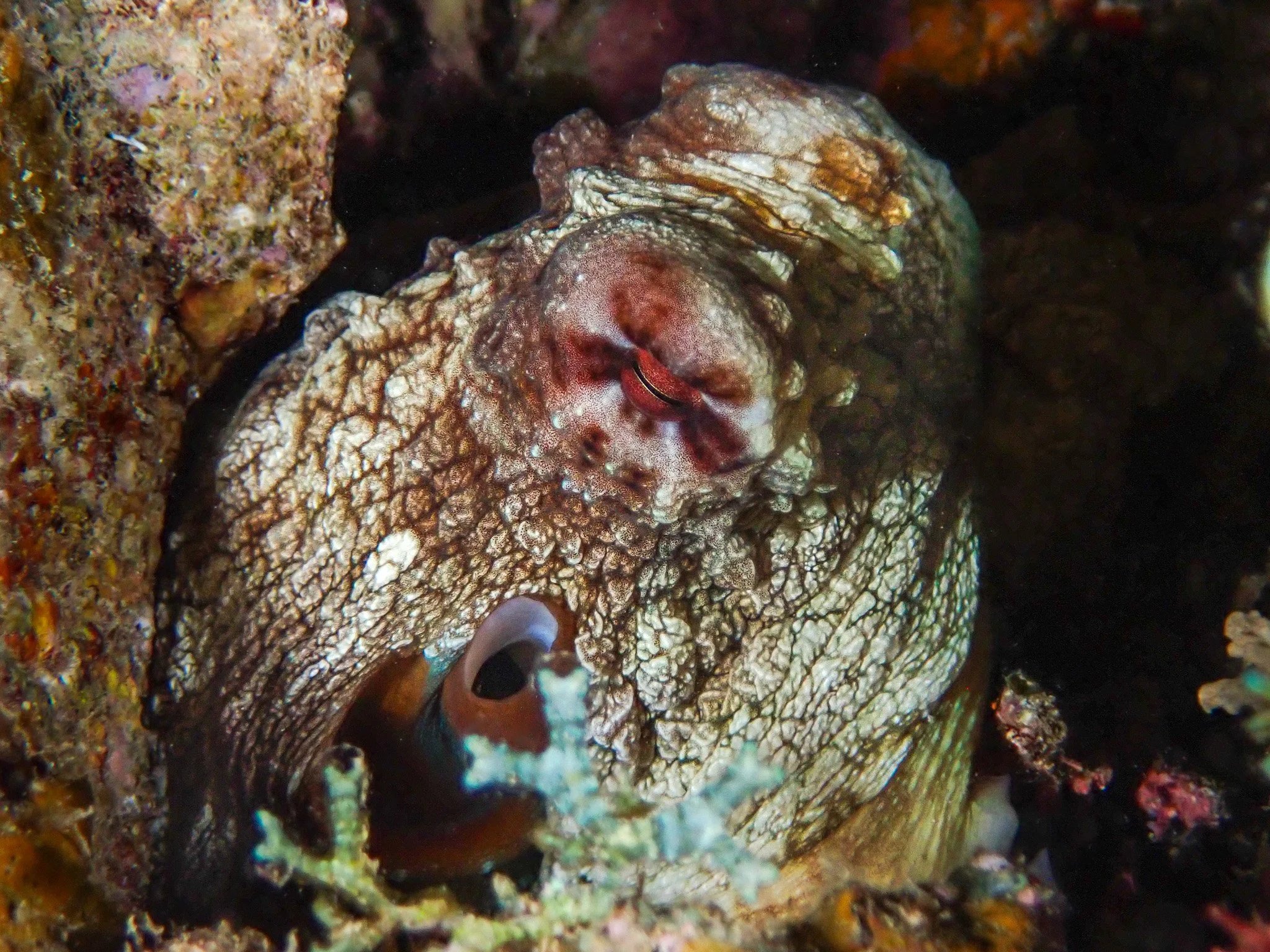
A day octopus (Octopus cyanea) showing off some incredible colors during a night dive in Fiji! I love the vibrant patterns and contrasting colors these octopuses can display as they move across the reef.
Still So Much to Discover
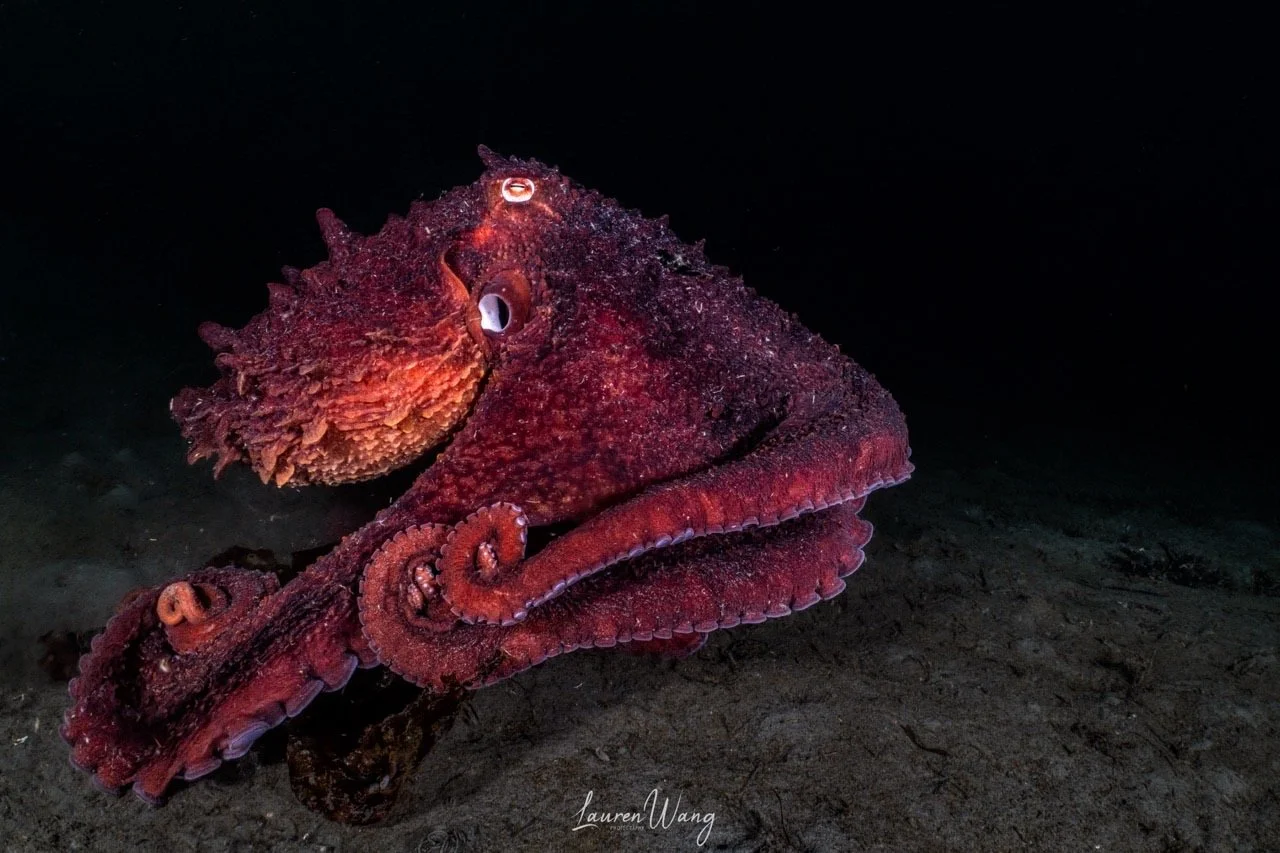
Just look at those beautiful curled arms! A giant Pacific octopus (Enteroctopus dofleini) showing off its rich red coloring and incredible skin texture off Vancouver Island.
Photo courtesy of Lauren Wang
One of the things I love most about octopuses is how much variety exists within a group of animals that many people think of as essentially the same creature. The day octopus blending into a reef, the coconut octopus carrying its portable shelter, the mimic octopus changing its appearance and movement, and the tiny blue-ringed octopus with its powerful venom all have different adaptations worth appreciating. The wunderpus wasn't formally described until 2006, and researchers continue to investigate the lives of species we've known about for much longer. There's still so much to learn about their behavior, reproduction, and the environments they depend on.
My trips to Lembeh and Fiji were especially memorable because I got to see so many of these extraordinary animals in different environments. Finding mimic, wunderpus, mototi, blue-ringed, algae, long-arm, and coconut octopuses in Lembeh, along with watching large day octopuses transform their appearances in Fiji, reinforced just how diverse these animals really are. I love watching how octopuses move, how they explore their surroundings, and how quickly they can disappear when they decide they've had enough attention.
Sometimes I get an incredible photograph, and sometimes I spend several minutes staring at a hole while my dive buddy wonders what could possibly be so interesting. Either way, I'm probably having a fantastic dive. Just don't be surprised when I signal for an octopus and you spend the next five minutes trying to figure out which rock I'm pointing at.
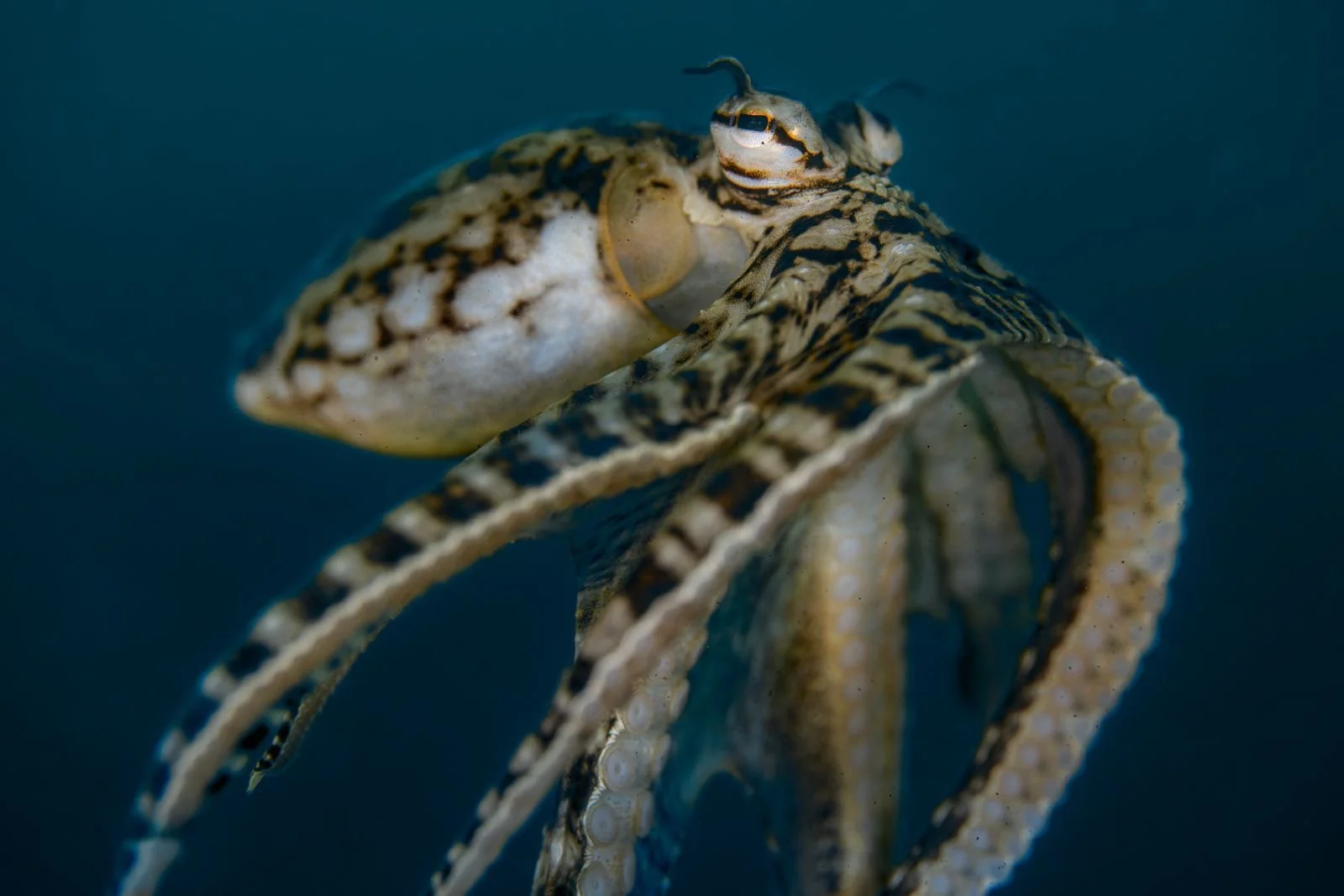
Those eyes, those arms, those patterns! A gorgeous mimic octopus (Thaumoctopus mimicus) captured by Byron Conroy
Dive safe, explore passionately, and remember…